Four by Four #52
Four Things To Read, Four Things To See, Four Things To Listen To, and Four Things About Me
I am happy to say that three poems from my manuscript called 2020 have been published by Unlikely Stories, “Making It Up As I Go Along,” “Since You Asked” (which is written in elegiac couplets, a form I have rarely, if ever, seen used in contemporary poetry), and “The Coming Storm,” which is a ghazal. I hope you'll check the poems out.
Just Here For The Comments, by Gina Sipley:
The difficult-to-track, hard-to-communicate nature of digital lurking is what makes it problematic for those who seek to monetize social media interaction. It is interesting to note that social media platforms are free of monetary cost for users because the payment for operating costs is derived from a user’s consent…to data collection and surveillance. Although selfish and greedy have been terms used to describe the behaviour [sic] of lurkers as individual internet users, lurking in this sense could more accurately describe the social media business model.
Sipley’s study of lurking on the internet—the book is based on her doctoral dissertation—occupies a really interesting space between the work of a public intellectual and that of a scholarly researcher. If you’re interested in thinking critically about your own online habits, Just Here For The Comments is chock-full of useful insights. I recognized myself at several different points as I read, and I found Sipley’s analysis of choices I have made both affirming and thought-provoking, especially when she connects her analysis to progressive socio-economic and cultural politics. One thing I found particularly interesting was how Sipley’s critique of the way lurking has historically been devalued for its refusal of proactive participation in online life recalled for me a similar critique of the assumption that students who don’t actively participate in class must be unengaged and are therefore unlikely to be learning. I found that point of view especially frustrating as an ESL teacher, since it implicitly denied the fact that there are cultures where “lurking” in the classroom—absorbing the content of a professor’s lecture without commenting or asking questions—is the culturally approved mode of learning. I will confess that much of Sipley’s scholarship was well beyond my normal purview, but I appreciated very much the degree to which her work demonstrated both the limitations of disciplinary silos and the value of forging connections between them, if not of breaking the silos down completely. Even if literacy—online or otherwise—is not your field, her work is a model worth taking into account when you think about cross- or inter-disciplinary practices in your own research.
§§§
Kiss The Scars On The Back Of My Neck, by Joe Okonkwo:
The characters in these taut, beautifully sculpted stories all find themselves at a crossroads where they must choose between different courses of action, each of which has its own moral valence and consequences that are either realized in the narrative or left to the reader’s imagination as it constructs what happens after the story’s completion. In some stories, the choice is whether or not to use and/or let themselves be used; in others, “like Skin,” it’s the choice to be honest with themselves about an ugly part of who they are. Sometimes the choice seems to work out in their favor, sometimes it doesn’t, and sometimes it’s the fact that they’ve made the choice that resolves the story and we may not even know precisely which choice they made. “Skin,” in fact, is one of my favorites. Terrence is a gay man consumed with physical self-hatred; he cannot stand his own scrawny body. The situation Okonkwo forces him into confronts him with the fact that he is no better than the men who will not give him a second, or even a first look because of how he looks. In “Paulie,” the eponymous sixteen-year-old main character, who is gay, ruins his mother’s love life out of spite, hates himself for it, but then finds comfort in a place he never expected to. The characters in these stories, all of them deeply drawn and compellingly complex, drew me in and would not let me go. Even now, weeks after finishing the book, I find myself thinking about them. I also appreciated the way Okonkwo worked jazz, the blues, opera, and visual art into the stories by making them a visceral part of these characters’ lives. Joe has read for my reading series, First Tuesdays, twice. Once from this book and once from his novel Jazz Moon, which I highly recommend as well.
§§§
“This Common Infection Was Thought to Affect Only Women. Now Doctors Know Better.” by Rachel E. Gross:
For years, doctors have known that the bacteria associated with [bacterial vaginosis] could also be found on the penis. Yet on paper [the condition] was just a vagina problem — it’s right there in the name, vaginosis. For 50 years, gynecology treated it as if it were solely a women’s issue, with ineffective treatments that left women vulnerable to re-infection.
I don’t remember if any of the women I’ve been with over the course of my life were ever diagnosed with bacterial vaginosis. With urinary tract infections, yes, but reading this article was the first time I’d ever encountered the name of this infection. Given that it was only as recently as 2012 that Cosmopolitan first printed the word “vagina” on its cover, and also that I remember only one of my lovers from before I got married more than three decades ago ever using the word vagina to talk about her own body, it would not surprise me to learn that a lover who had been diagnosed with bacterial vaginosis might choose to avoid the discomfort associated with the word by calling it a UTI instead. (Given the state of the culture thirty or forty years ago, it also wouldn’t surprise me to learn that she would have assumed the discomfort would be more mine than hers.) In any event, Gross’ article is very much worth reading. A couple of my takeaways: First, the fact that the bacteria causing bacterial vaginosis can live in semen demonstrates in unavoidably concrete terms that the emotional and psychological “ecosystem” created by a sexual encounter needs to be expanded to include the biological as well. Second, the way in which Gross discusses the permeable and contested boundaries of terms like “sexually transmitted infection” illustrates quite powerfully the ways in which social attitudes and cultural values shape and inform medical science. That is not a new insight, of course, but it was interesting to see it so starkly illustrated. It’s also worth reading the article for this bit of medical history:
Like most advancements in modern gynecology, the discovery of bacterial vaginosis can be traced back to a male doctor experimenting on his patients without consent. The doctor, Dr. Herman Gardner, suspected that B.V. must be a result of some pathogen being transferred back and forth.
In 1955, Dr. Gardner performed an appalling experiment to find out. He transferred vaginal fluid from 15 women who had B.V. into the vaginas of women who did not have the condition, and he allowed the newly infected women to pass B.V. on to their unsuspecting husbands.
Upon culturing bacteria from some of the husbands, Dr. Gardner declared B.V. to be “the most prevalent and one of the most contagious” of all S.T.I.s. For his efforts, Dr. Gardner’s name was forever enshrined in the species of bacteria most associated with B.V.: Gardnerella vaginalis.
Acrobat, by Nabaneeta Dev Sen, translated from the Bengali by Nandana Dev Sen:
Poetry flies away as well,
if you let go of the thread—
it flutters in space like a lost kite.
The poet floats in an infinite void, desolate,
like a spacecraft disconnected from earth,
with no destination.
I’ve chosen these six lines from a poem called “And Yet, Life,” which appears towards the end of this volume—a collection spanning a sixty year career—because their subtext, the idea that poetry is that which connects the poet to the world, is the thread around which my experience as a reader cohered. Read carefully, each poem in the book reveals itself as something that needed to be written, not because the world required it, but because the poet’s consciousness and conscience did. “This Child,” for example, which opens with the line “One day this child too will die,” confronts a question with which children by their very presence ask of their parents: Why did you bring me into this world. Dev Sen’s speaker, “Choking with fear, with ignorance,” tells us this question will make her “run away/to a dark cave, numb and empty” because she has no satisfactory answer to give. In “Growing-up Lesson,” she addresses a boy who fears the requirements of manhood—the most interesting line in the poem, to me, is “Are you terrified of plucking virginity?”—and then offers, as (a perhaps ironic) alternative, the kind of strength and maturity and analogous manhood that can be found in the use of words. In some ways those different but related spheres of concern—that of a parent responsible for a child’s life and that of a woman turning a critical eye on patriarchal gender roles—are the poles between which all the poems in the volume move. In her moving introduction to the volume, Nandana Dev Sen, the poet’s daughter and translator, offers a quote from her mother that I think speaks to what makes this book worth reading as more than just an interesting volume of poetry in translation: “I speak of poetry as being central to woman’s freedom. Yes, I am partial, I cannot be and do not wish to be objective…”
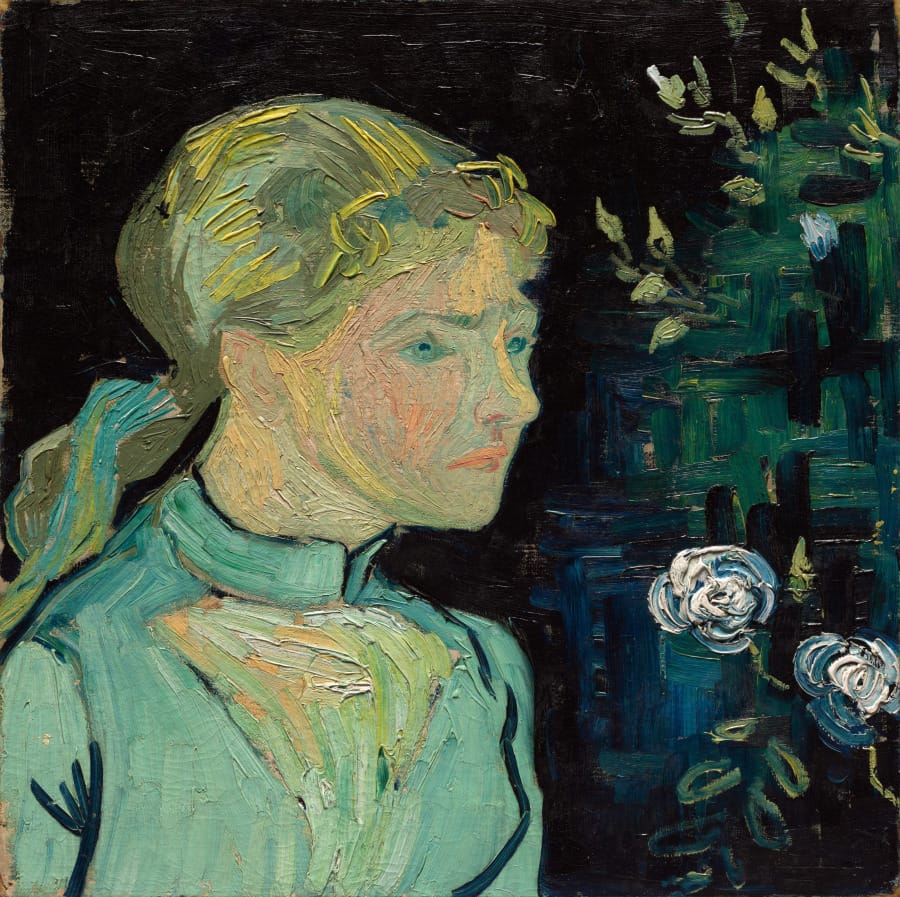
This portrait, completed during the last months of van Gogh’s life, depicts Adeline Ravoux, 13-year-old daughter of Arthur Ravoux, from whom van Gogh rented a room in Auvers, a small town north of Paris. (This image is from the Cleveland Museum of Art.)
§§§
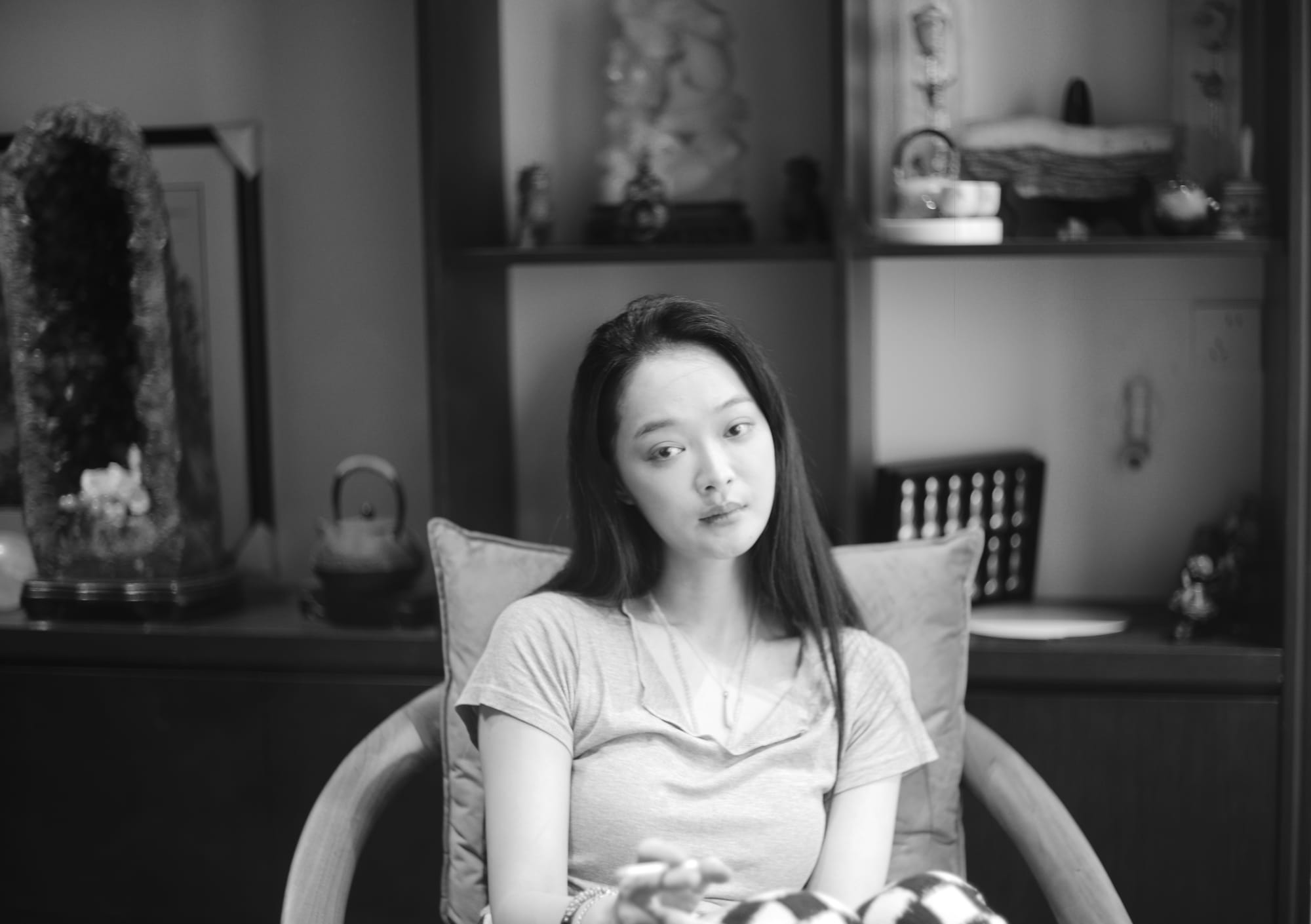
Yan Yan is a Chinese actress and former singer who continues to act in Chinese film series and now owns a media company. She won Chinese singing contests when she was 16, acted in two famous Chinese film series and then took a break for two years before resuming her acting career. Young female Chinese actresses have had to face the same challenges that their Hollywood counterparts have faced in the past. Norman was a colleague of mine. You can find more of his work at the Chinese Independent Film Archive, I See the World through the Lens of My Camera.
§§§
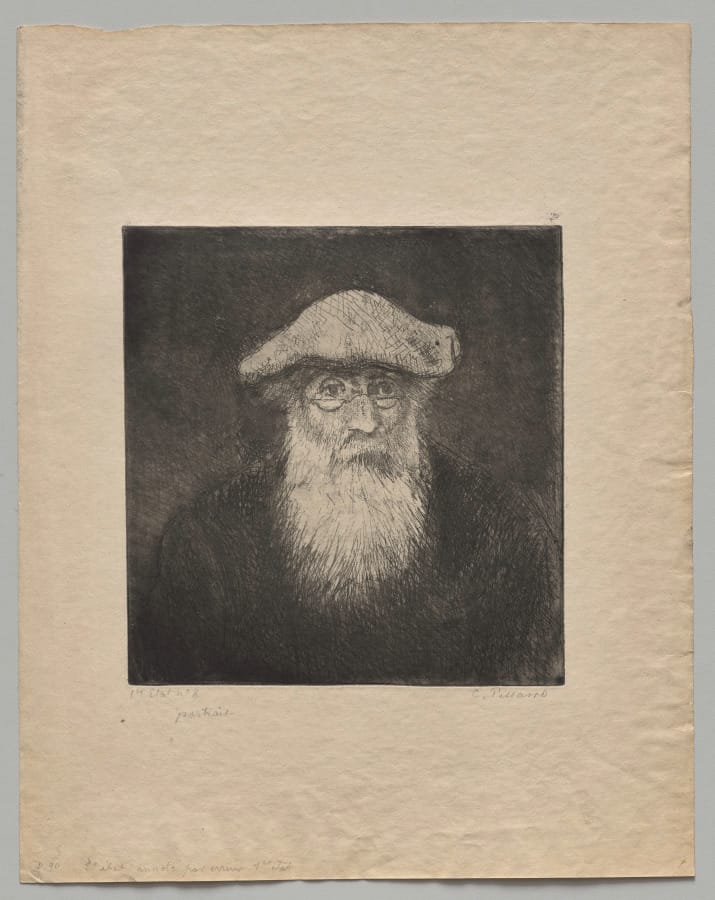
This print is of Camille Pissarro’s only etched one self-portrait, made when he was 60 years old or so. The image is from the Cleveland Museum of Art.
§§§
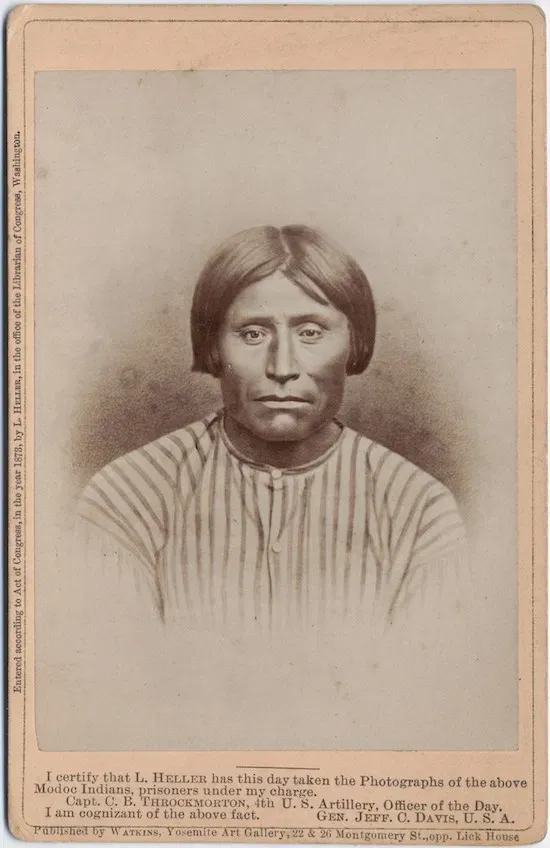
The Modoc War took place between 1872 and 1873. This image, taken by Louis Herman Heller, is part of a collection of pictures he took of Modoc warriors captured by the United States Army during that conflict. One-hundred-fifty-three Modoc were held as prisoners of war until 1909.
§§§
§§§
§§§
I live in apartment 61, in the building next to the one in which my grandparents also lived in apartment 61. The living room and dining room in the front of my apartment are laid out just as they were in my grandparents’ apartment, which means the view from our windows is the same view, essentially, as the view they had from theirs. Every time I look out the window from the seat where I am sitting now, at the southeast corner of our dining room table, I am struck by the memory that this was exactly where I sat in my grandparents’ dining room for dinner every Sunday for as far back as I can remember. I didn’t always sit there on holidays, when there were many more people around the table. After my grandfather died, I migrated to his seat at the head of the table, especially on Passover, but in my memory, accurately or not, the seat where I am sitting now is the seat that was mine back then. I didn’t intentionally choose to make this my seat at my own dining room table. I just naturally sat here from the moment we started living in this apartment.
§§§
When I was younger, I was an athlete, not a star by any means, but I loved to play sports, basketball in particular. In the yeshiva, I was one of the two tallest boys in the class, and of the two of us, I was the better ball player, which meant I got to play starting center on our basketball team. When I graduated from the yeshiva in 11th grade and decided to do my senior year in high school, though, I was suddenly only tall enough to play forward and there was no way I could compete with the guys who’d been playing true high school ball since before they were in 9th grade. I did in fact make the team when I tried out, but I learned that I was second string at best. That’s not why I decided not to play, though. I quit the team because I realized two things. First, I didn’t care enough about winning. Yes, I liked to play, but I didn’t have the competitive edge that my teammates did, and—though I never would have put it this way back then—I didn’t like the testosterone-heavy ethos I was expected to adopt as a team member. Second, and in some ways more importantly, I began to realize that I felt most at home with the artistic kids. I thought of myself at that point more as a performer than a writer. I was playing horn in the local drum corps; learning to fake my way as a piano player; and I really enjoyed being on stage. I still liked to play sports, but being an athlete was not central to my identity, and I found myself over the years playing less and less, and, even when I was around people who did play, being asked to play less and less. I started to think about this just now because I remembered the one and only time I tried to go skiing. I have never understood the appeal of that sport. You go up a hill to go down a hill, just to go back to the top to do it all over again. I get that it takes real skill and that the trip down can be exhilarating, but the experience never called to me as something I wanted to have for myself. Anyway, we were visiting my sister-in-law in Canada and my son wanted me to try snowboarding with him. I was game, but I was not prepared for how out of shape I was. I could not maintain a center of gravity and I kept falling on my ass—to the point where I had to ride my ass down the beginner’s hill, not the board my feet were buckled into. I laugh about it now, but it was really embarrassing at that time.
§§§
Back in 2012, in this blog post on Alas, I wrote the following:
but it has been years since I have been able to create at the center of my life a space for the kind of reading that nourishes me as a writer, reading that puts me back in touch with myself just for the sake of that experience, that connects me to language in ways that are challenging and revitalizing, that affirms my right to claim a place in this world simply because I am, that shapes who I am and shows me possibilities of being I would not otherwise have imagined.
Now that I am retired, I am finding it easier than I thought to get back into the rhythm of that kind of reading, and including books in the “Four Things To Read” section of Four By Four has helped as well. The comment is still a fair one, though, if only because I can’t help but feel the tug—as I am sure you do too—of the digital world, reminding me that I might miss something I do not want to miss if I don’t start scrolling on my phone right this second. One of the regular Alas commenters responded to my post by asking if I could give an example of the kind of reading I was talking about. The post I wrote in response is dated in ways that make it not worthwhile to reproduce here, even in miniature, but part of that post was a list I made of books that had made a difference in my life. It’s kind of long, so I’ve put in the toggle box below for those who are interested:
§§§
The first gay bar I ever went to was called The Betsy Ross, located on 37th Road in Jackson Heights, a strip that was known back in the 1970s—though I had no way of knowing this at the time—as Vaseline Alley. I was sixteen years old, which makes the year 1978, and I was working as a waiter and (underage) assistant bartender for the local Jewish Center’s catering hall, which was owned by a friend of the family. The bartender was a guy whose name I remember as John. He and I had become friendly over the course of the couple of months we’d been working together. I enjoyed talking to him because he didn’t treat me like a kid. On this particular night, as we cleaned up after an affair, he asked me if I had a girlfriend. When I told him yes, that we’d been seeing each other for about six months, he said something about how, at sixteen, “that must seem like an awfully long time.” When we were finished cleaning, he asked me if I wanted to keep talking. When I said yes, he told me to get my coat and we walked over to the Betsy Ross. I remember white lettering on a black background over closed, matte black doors, with no one out front. Once we were inside—I also recall whoever was watching the door greeting John as a regular and nodding a smile in my direction—it was pretty obvious where we were. There were no women, and two men in white, hip-hugging bell-bottoms and skin-tight shirts were dancing more sensuously in the sparkle of the disco ball than I’d ever seen anyone dance before. At first, I couldn’t stop staring. Once we were seated, John ordered whatever he was drinking and a Pepsi for me and then he said, “You know you’re in a gay bar, right?” I nodded towards the men on the dance floor and said, “Yes, I know.” He reached over and touched my face. “I knew you’d be cool about it,” he said and told me the story of why he was no longer a cop—which now that I’ve written it makes me think that was the subject we’d switched to after talking about my girlfriend. Back then, you couldn’t be a cop and be out of the closet and John had refused to hid who he was. He’d had no choice but to leave the force. Then a friend of John’s joined us at the table. We talked about I-don’t-know-what until I said I needed to leave. We said goodbye and, though I’d hoped to see John at the next catering job, I did not. After that night, I never saw him again.
You are receiving this newsletter either because you have expressed interest in my work or because you have signed up for the First Tuesdays mailing list. If you do not wish to receive it, simply click the Unsubscribe button below.
It All Connects is for anyone who grapples with complexity—of identity, art-making, culture, or conscience—to make a difference in their own life and, potentially, in the life of their community.





Member discussion