Four by Four #55
Four Things To Read, Four Things To See, Four Things To Listen To, and Four Things About Me

A poem from 2020, “The Only Lit Storefront on The Block,” appears in the most recent issue of Glimpse.
A Brief History of Israeli Denialism, by Charles Lenchner: Fair warning, this is a graphic quote:
I’m Jewish. I grew up in Israel. I was in the IDF (and later went to prison as a refusenik). [I]’m...not at all surprised by...the bizarre nature of the denialism [concerning Kristoff's article]: open discussion of whether and how dogs could be trained to rape a man. It boggles the mind that those would be the straws being clutched. For all we know, the dogs didn’t insert their dog penises into the rectums of Palestinian prisoners. Maybe they only humped the men while they were bent over, naked. Maybe they lunged at the men’s genitals. Maybe a prison guard smeared peanut butter on someone’s ass and laughed as a dog licked it all up. Do you see now why this entire line is insane? The minute you have naked prisoners and dogs interacting AT ALL you’ve lost.
The Kristoff article Lenchner is referring to, if you haven’t read it is here. I linked to a related piece from Al Jazeera in my Of Note from May 11. I remember reading Barbara Ehrenreich’s essay about coming to terms with women soldiers taking part in the torture of Iraqi prisoners at Abu Ghraib. She wrote about—this is my paraphrase—a certain kind of feminist naïveté died that day with the realization (which, in all honesty, should not have been a realization for anyone who did not otherwise believe biology is destiny) that a uterus is not a substitute for a conscience. The corollary here should be obvious. Those of us, Jewish or not, who had an analogous kind of naïveté about Jews and Israel drummed into us from a young age have had ample opportunities to be disabused of that innocence over the years. This is yet another one. Please read this essay.
§§§
Letters from an American: January 31, 2026, by Heather Cox Richardson:
History is doing that rhyming thing again.
I know this “Letter” is now several months old, but it is still very much worth reading, since the rhyming to which Cox refers is still very much going on. To take one example, she connects Stephen Miller’s recent call “for a ‘labor class’ excluded from citizenship and a voice in government” to the words of South Carolina Democratic Senator James Henry Hammond, who argued in 1858 that in “all social systems there must be a class to do the menial duties, to perform the drudgery of life.” Hammond, of course, was arguing in favor of slavery, but as Richardson shows, his argument also pulled away the veil that obscures the connection between the exploitation of the enslaved and the exploitation of the working class. I don’t mean, of course, and neither does Richardson, not even my implication, that to be working class is equivalent to being enslaved, just that the statuses “rhyme” at the bottom end of the same, capitalist, socioeconomic continuum. Richardson goes on to make a number of other connections along the same lines, keeping her prose laser-focused on what the Trump administration has been doing and the small signs of hope and resistance that are sprouting up. The piece is very much worth reading.
§§§
The Strangers, by Eugene Lim:
“You’re much more devolved than the people you see as dupes or even those you see as self-justifying puppet masters. Because your mind cannot fathom the complex plot, the infinitely varying story, the total story which you can never, will necessarily never, completely understand—in response you fake it. You make up grand narratives that reduce the world to heroes and villains, to victims and thieves. You’re a child.”
Two books that kept coming to mind while I was reading The Strangers were The Waves, by Virginia Woolf and Stand on Zanzibar by John Brunner. These associations are entirely intuitive, since I read both those books long enough ago—in particular Stand on Zanzibar—that I remember neither of them clearly. If I try to make sense of thee connections, I would say, in the case of The Waves, it has to do with the way Lim has his characters externalize their inner consciousness in their speech and how, especially in the final chapter, he weaves, or at least gestures towards the weaving of, more than one consciousness together. The Strangers is very different from The Waves, but this is a connection I felt. In the case of Stand on Zanzibar, I think the connection I felt had to do with how the disparate narratives in The Strangers, and the way they ultimately come together through discrete points of connection, in terms both of plot and of language, create a world that is globally dystopian. I won’t say more than that because I don’t remember Stand on Zanzibar well enough to know if I am at all on target. My favorite part of The Strangers is the one in which a man who has been marked for death by his totalitarian government escapes. The story told by the first person who helps him—in a structure reminiscent but also deconstructing of The Canterbury Tales or The Decameron are masterly set pieces that expose and satirize what totalitarianism does to the minds of the people who live under it.
The Hit Erotica Writers Outwitting Nigeria’s Religious Censors, by Ruth Maclean and Ismail Auwal:
For decades, northern Nigeria has been home to a booming industry of romance novels, written in Hausa by and for women. But in a region that operates under a dual legal system, where Shariah law exists alongside secular courts to strictly regulate public morality, steamier stories are deemed immoral. Some books have been publicly burned by zealous officials. Now, a new generation of writers is publishing far more explicit content — and serializing it on WhatsApp, where it is out of reach of religious and government censors who are still focused on paper books.
This article focuses on one of those writers, Fauziyya Tasiu Umar, who goes by the pen name Oum Hairan. The authors refer to her throughout the article as Mrs. Umar, which is no doubt a nod both to the fact that she is able to speak openly about her work because she is married to a man who supports what she does and to the way she characterized her work when she was called in by the Hisbah, the religious police: “Her books,” this is the authors paraphrasing her, “were targeted at married women…and the point was to convey messages about society…Indeed, in a kind of foreword to each book [she] forbids young, unmarried women from reading them.” The Hisbah let her go. It’s tempting to see this simply as a variation of the strategy pornographers in this country once used to justify their work by demonstrating that it had redeeming social value, but that surface similarity obscures the fact that, as the authors point out, “Hausa women have long had varied erotic lives even as they navigate strict public moral codes, cultural commentators say. A 1954 anthropological biography, ‘Baba of Karo,’ details how Hausa women often had 10 or 20 secret lovers.” This essay, “The Hidden Life of a Kiss,” has screenshots of the relevant passages from that book. I have not commented here on the fact that the women producing these works also profit from them—one woman says she earns more from her erotic novels than from her regular job—or that the women are able to evade the religious censors because they write, and their readers read and pay, entirely on their phones.
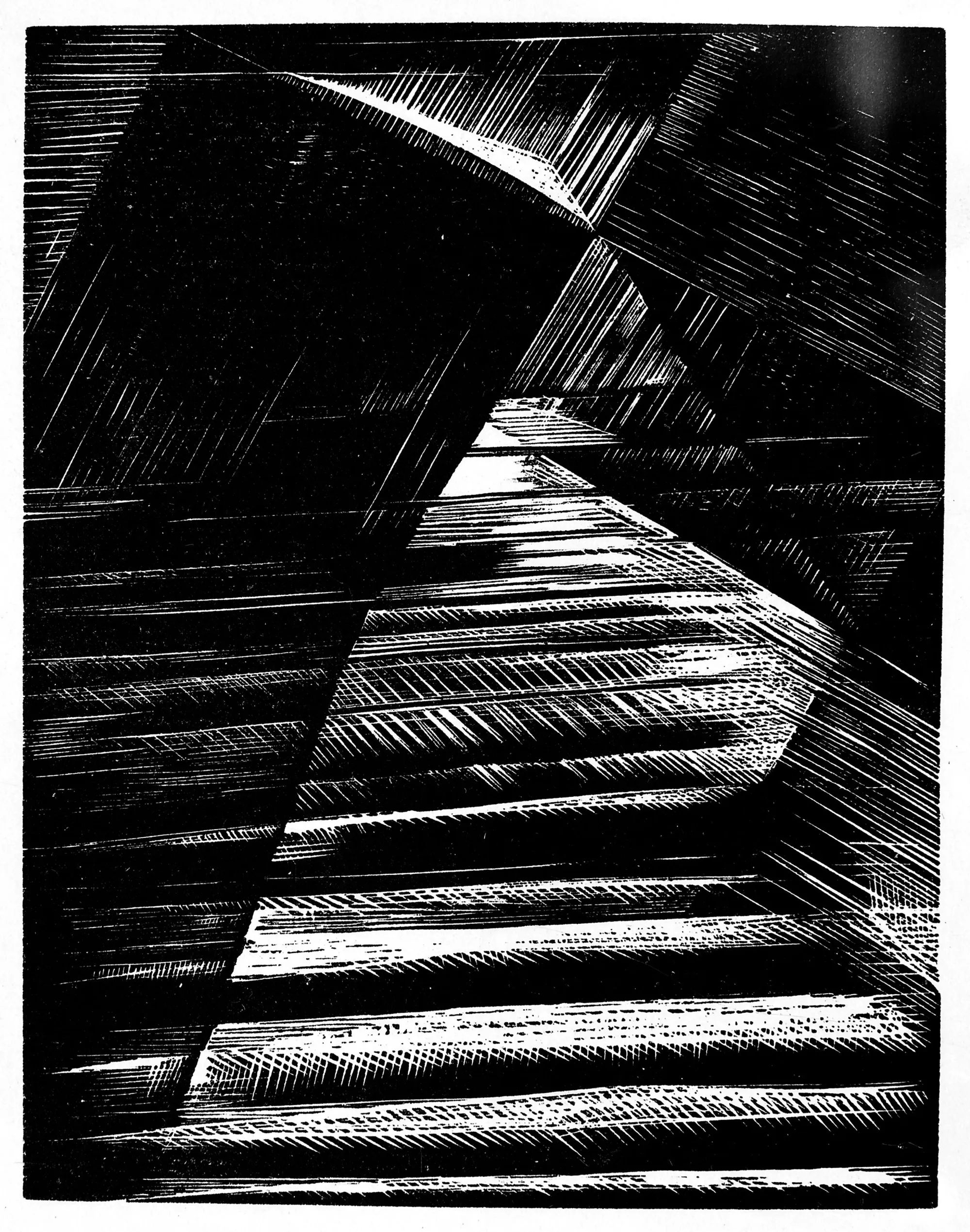
I found this image in The Public Domain Review, which is a wonderful resource. This engraving is from Nash’s book Genesis, which was published in 1924 by Nonesuch Press, which the Review described as an independent press “founded in the early 1920s by socialists and bisexuals in a basement in London’s Soho [with the goal of making] beautifully designed books less precious and more available; they typically used a commercial printer, but mimicked the handpress aesthetic.” The Review’s write up also includes a short, useful biography of Nash.
§§§
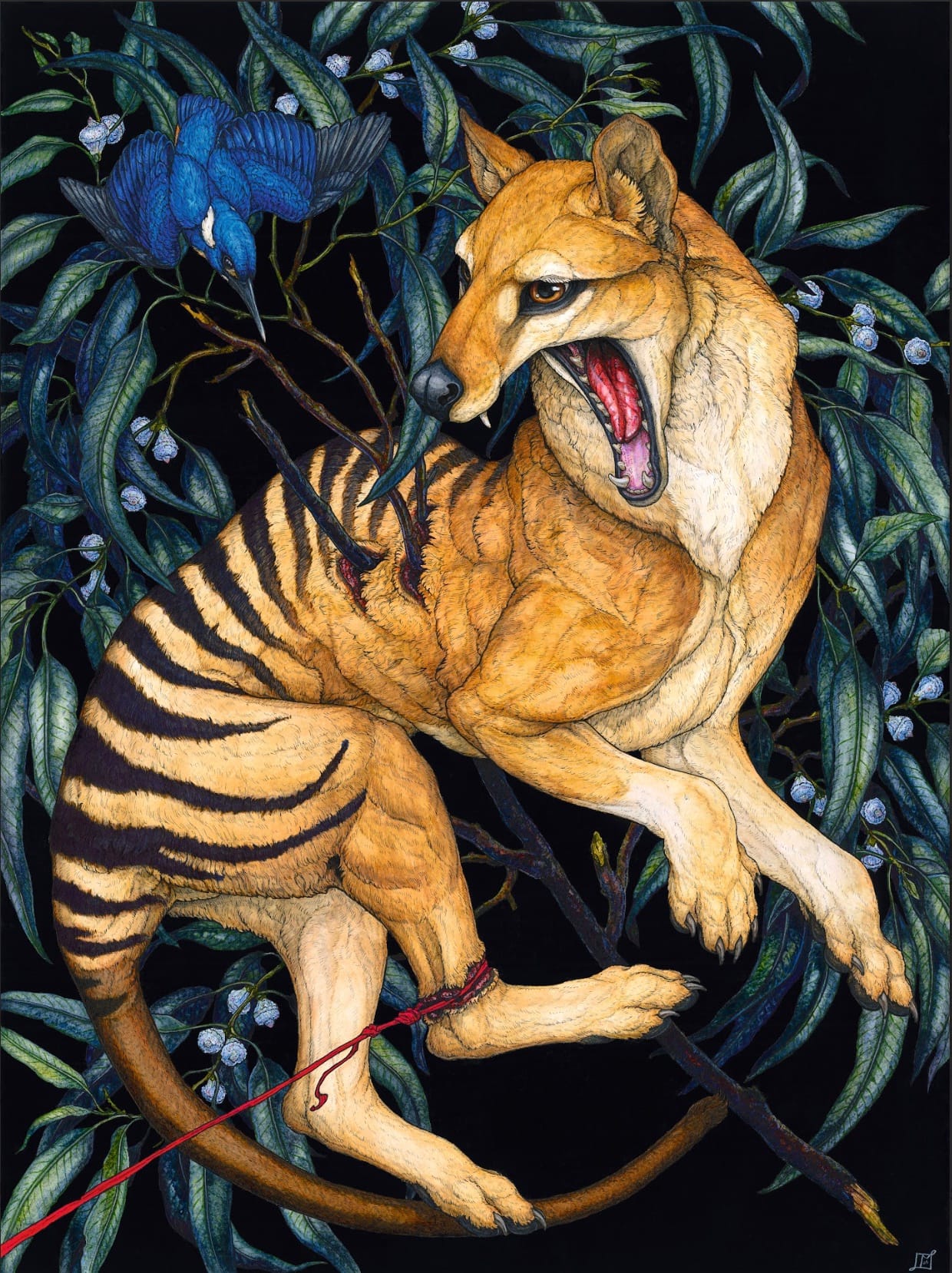
I found this image in an article in Orion magazine about Lauren Marx’s work. This is Orion’s description of 1936, the subject of which is a Tasmanian tiger:
As a cryptid, the thylacine (Tasmanian tiger) is treated as a mysterious, possibly surviving predator long after its official extinction in 1936. Resembling a large dog with stripes along its back, the thylacine was a marsupial carnivore native to Tasmania, Australia, and New Guinea. Sightings and tracks reported over decades fuel cryptid lore, with enthusiasts speculating that small populations might still roam remote forests. Its cryptid status blends fact and legend: a real, recently extinct species that continues to haunt the imagination of those fascinated by elusive, hidden wildlife.
§§§
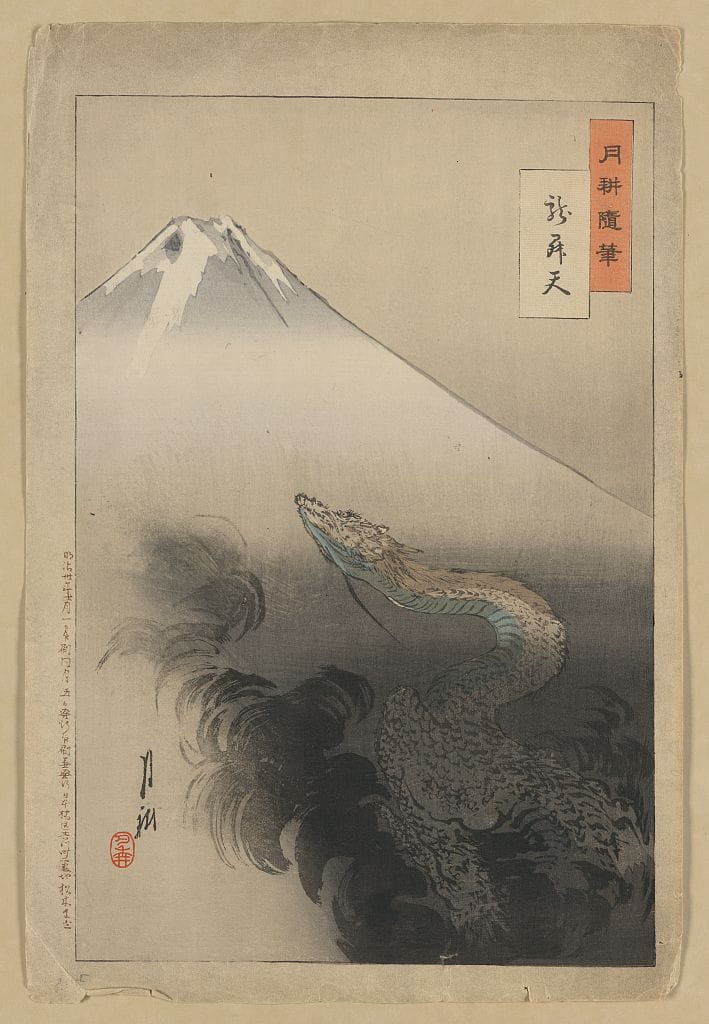
Gekko was a Japanese artist best known as a painter and a designer of ukiyo-e woodblock prints. He was self-taught in art, won numerous national and international prizes, and was one of the earliest Japanese artists to win an international audience.
§§§
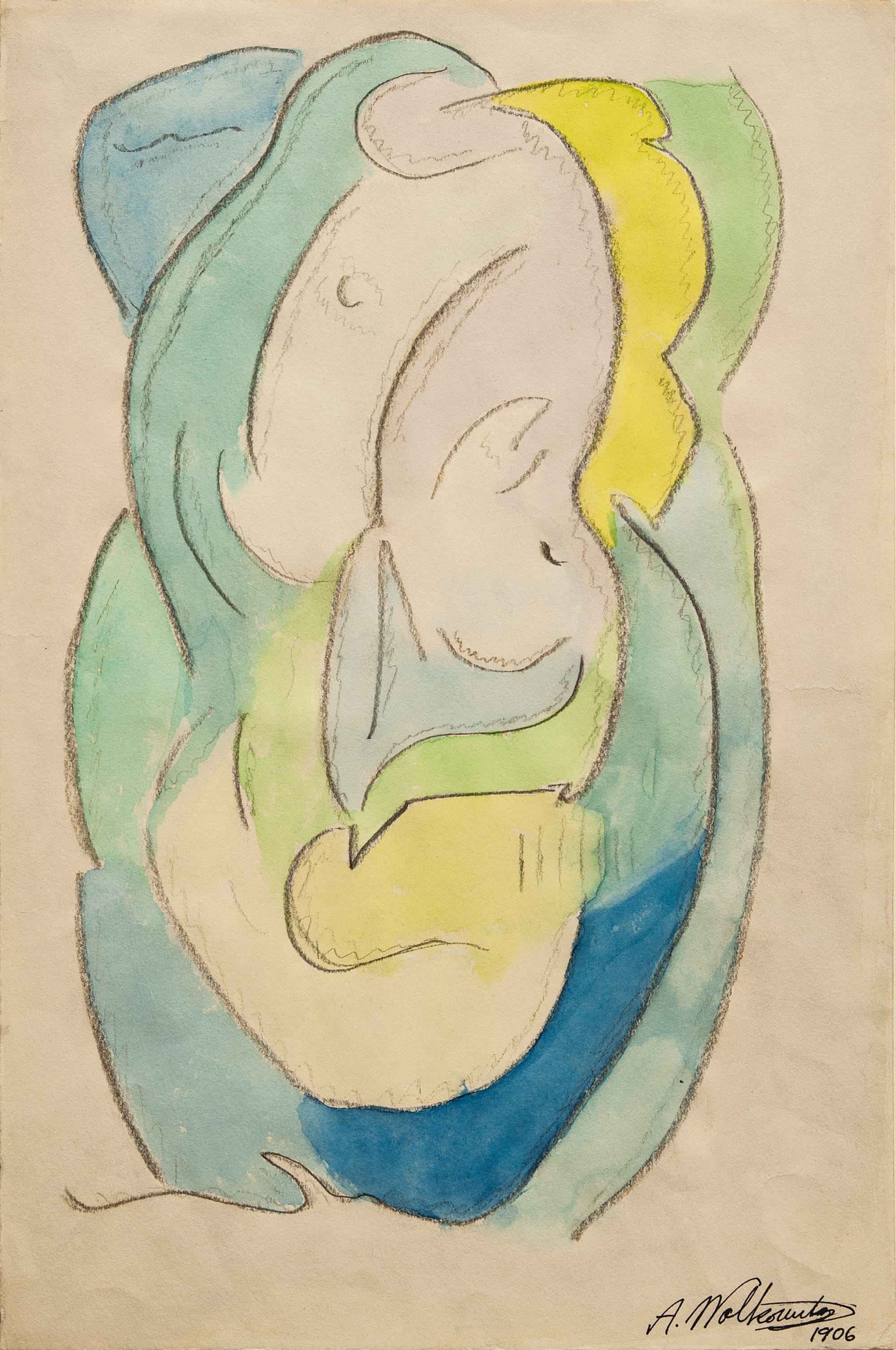
Walkowitz was a Russian–American painter who, while not having attained the same level of fame as his contemporaries, nonetheless worked at the center of the modernist movement. He is also known for having made over 5,000 drawings of Isadora Duncan.
§§§
§§§
§§§
When I decided in the mid-1980s to get my MA in Teaching English to Speakers of Other Languages (TESOL)—notice it is not teaching English as a second language—I did so because I perceived the field to be politically progressive, both in form and content. I understood the job of ESOL teachers here in the States as fostering a kind of equity and inclusivity that was sorely needed. In fact, one of the reasons I decided not to pursue a PhD in Applied Linguistics, even though I was fascinated by the study of syntax and semantics, was that those fields seemed very far removed from anything that might have a real and lasting impact on the lives of ordinary people. I remember reading articles in TESOL Quarterly and elsewhere about the politics of using English as a language of instruction in pre- and post-apartheid South Africa, about the concept of what I think they called at the time and maybe still call “language rights,” the idea that communities had a right to their native language(s) regardless of what the dominant language in a country might be; and I remember being blown away by the concept of language maintenance, the idea that students for whom English was an additional language ought to be given the opportunity to maintain grade-level competence in their home language. (I’m pretty sure that was the term used at the time.) I intuited immediately that these issues should not be put in a silo where they applied only to immigrants—who were, at the time, the population I was most interested in working with—that the questions raised by those positions impinged on language politics as a whole in ways that mattered to native speakers of English too. Once I began teaching, however, and especially once I became the English as a Second Language Coordinator in my department, I had less and less time to worry about those larger issues. Instead, I found myself dealing far too often with the ignorance of professors who knew next to nothing about my field. Sometimes that ignorance was “honest,” in the sense that the professor knew they knew very little about the issues ESL students brought to their classrooms and they were willing to learn. Other times, and at its most extreme, this ignorance was willfully and proactively racist. I remember one instance, where a professor brought me two diagnostic exams written by, he said, “Spanish speakers” who had been misplaced in his class. “And you know how Spanish speakers are,” he told me. “They constantly drop verb endings and they don’t understand subject-verb agreement…” He handed me the essays and went off into the rest of his day. It turned out that these two Spanish speakers were from Haiti and Jamaica respectively. More than that, the Hatian student’s writing was near-native in fluency. She had made one error in the future perfect progressive. The Jamaican student’s writing, on the other hand, bore all the markers one would expect from a student who spoke a dialect other than so-called standard English and who, for whatever reason, had not acquired enough competence in the standard dialect to write at a college level. Clearly, these “Spanish-speaking” students did not belong in that professor’s class, and I was able to move them into classes with instructors whom I knew did not have the kinds of preconceptions that could do those students harm. I will never forget what the Haitian student told me when I met with her. She said she recognized the professor’s racism immediately, but racism had been till that moment an abstraction to her. She came from a country where almost everyone was Black, she said, and she’d been at a complete loss as to how to respond to him when he said he was referring her to me. I have no idea how prevalent that kind of ignorance is now among teaching faculty at any level of instruction, but I have never forgotten that experience as an object lesson in how important it is for educators, and perhaps especially teachers of writing, to know something about other-than-first-language (or dialect) acquisition.
§§§
Starting about five or six years before I retired, I participated in a volunteer initiative on my campus called Conversation Partners. Started by the ESL Program, Conversation Partners paired native English speaking faculty with ESL students so the students would have a chance to practice conversational English. One year, I was paired with a student from the People’s Republic of China whose name I don’t remember. She’d come to the States to study English and a subject I also don’t recall but that she had chosen so she could join her father’s very successful business when she returned home. Her father was a very rich, very powerful executive, with government connections. Towards the end of the semester, we had the one conversation that I remember clearly. It was about the Tiananmen Square massacre, which she said never happened. It was an awkward moment to say the least. I wish I could reconstruct how the subject came up, because I had been very careful to keep politics out of our conversation, and I think she had been as well, not wanting the obvious ideological differences we might encounter to get in the way of why we were meeting: so she could practice her English. Nonetheless, I could not let the moment pass and so I called up on my computer one of the videos that had circulated at the time. She watched it in silence, as did I, and she said not a word when the video was finished. I don’t remember if we met after that, though I’m assuming we did because at the end of the semester she gave me this as a gift:
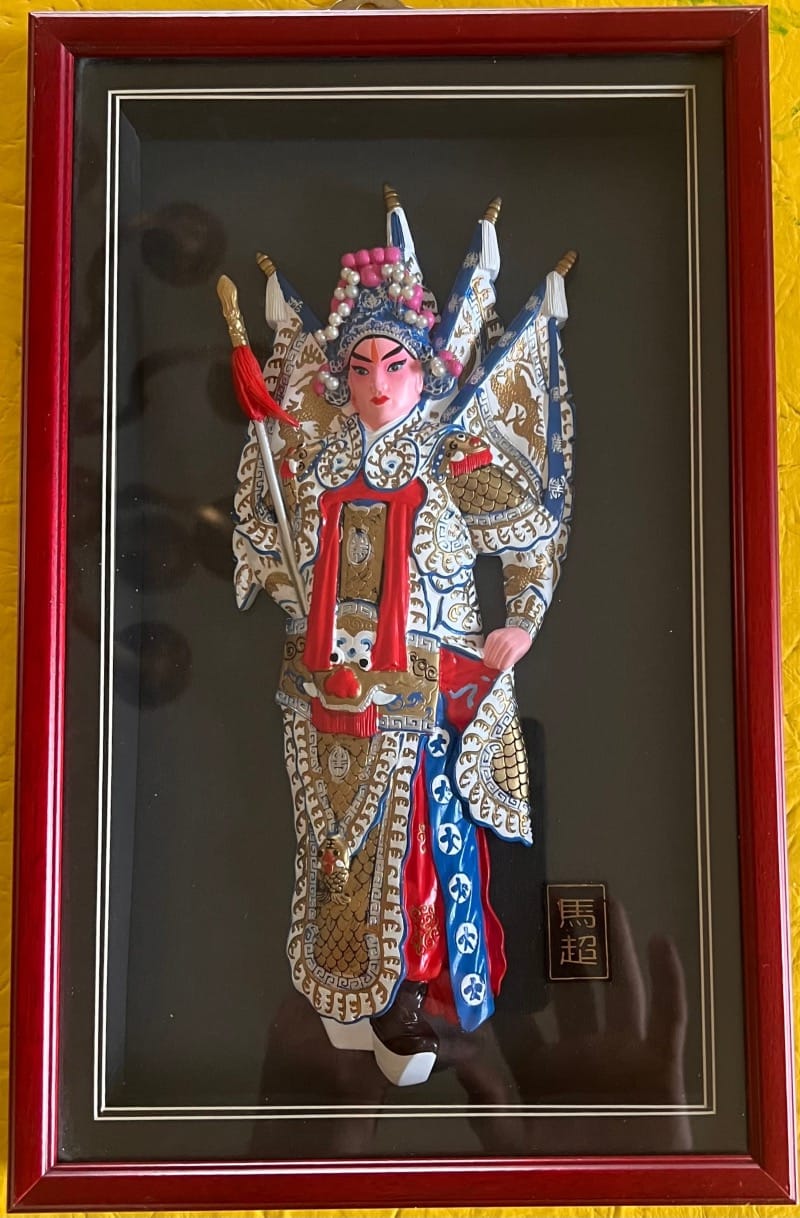
I have no idea if she intended the gift to have a symbolic significance and I have nothing else to say about my encounter with her, except to acknowledge that, writ large, the silence in which we sat after viewing that video is a silence that people across the world try far too often to hide, and to hide from, than to fill with anything meaningful. It is worthwhile, I think, to name it for what it was.
§§§
There is an essay I will probably never write about a book I was going to write, but won’t. It concerns a group of people I know well, who have a story that I once thought it would be important to tell. I went to each person whose life this book would have touched upon and asked if they thought the book project was worth pursuing and they said they did. Based on that, I submitted a query letter to an editor at one of the major publishing houses. She expressed some interest in the project and I began work on the proposal. Very soon after that, though, I heard that one of the people I’d spoken to was saying that the only reason I wanted to write the book was to make money off of their story. I stopped work on the project immediately, though I kept that fact to myself, preferring not to cause the kind of drama that confronting them would have caused. This was almost twenty years ago, and I have said not a word about the book since. Every so often, though, I hear things that indicate they are still thinking about it. Once, through the grapevine, I heard that one of them threatened to sue me if I ever tried to write it. He even said outright to someone who asked me whether I was still working on the project, “Richard knows better than that. He’s been warned.” Whatever window of opportunity there might have been for the story I thought we’d all agreed was worth telling is long past, so, frankly, even if they suddenly wanted me to pursue the project I would not now do so; and, if I’m being honest, if I thought writing it was worth the fallout, the essay is more interesting to me now anyway. It’s not worth it though, which is why I’ve written about it here, just to get it out of my head.
§§§
A couple of weeks ago, on one of the rare occasions that I was scrolling through Facebook, one of my sisters—I have two and we are estranged, as they are long-estranged from each other—appeared in my “People You May Know” stream. I was surprised to see her there, though I think the algorithm probably surfaced her because of a thread of mutual connections that we have on the platform that go back nearly forty years. Anyway, I was curious, so I went to her profile page to see what I could see, and I was pleasantly surprised to learn that she has begun making and selling some truly beautiful art. “Pleasantly surprised” is actually not quite accurate. I was happy for her. I remembered a conversation I had long forgotten when I tried to convince our our grandmother to buy her as a graduation gift a truly high quality “artist set”—paints, brushes, colored pencils, whatever. My sister had talent and she had talked to me about wanting to develop it. My grandmother, however, demurred. “She’ll never be able to make a living doing that,” she said. I don’t remember what gift she bought instead, but as far as I know my sister stopped drawing after high school. So it made me happy to see her making art and also sad, since—and you will have to take my word for this—my happiness for her is not sufficient reason to reach across the chasm of our estrangement.
You are receiving this newsletter either because you have expressed interest in my work or because you have signed up for the First Tuesdays mailing list. If you do not wish to receive it, simply click the Unsubscribe button below.
In a world that seems more and more troubled by disruption, It All Connects is where I work out for myself how to live in, with, and through the identities that define me.



Member discussion