Four by Four #58
Four Things To Read, Four Things To See, Four Things To Listen To, and Four Things About Me
Usually, I include in “Four Things To Read” quotes from/summaries of/responses to essays—and sometimes books—that I think will be of interest to you. This month, though, it’s been difficult to keep up with that because of other, volunteer obligations I’ve taken on that turned out to be, as these things usually are, more time consuming than I had anticipated. I don’t begrudge the hours I’ve spent on this other project, since it is of crucial importance to me and my neighbors, but it has meant that I haven’t been able to give my own work the attention it deserves and August’s “Four Things To Read” has suffered as a result.
August, however, is also the month of The Sealey Challenge, which was started in 2017 by the poet Nicole Sealey and has been presided over by the University of Arizona’s Poetry Center since 2023. The idea is simple, though this is my own way of saying it. Set yourself the aspirational goal of reading one book of poetry a day and then use that goal as motivation to read as much poetry during the month as you possibly can. I sometimes do and sometimes don’t take part in the challenge, but I decided I would this year because, in a conversation with my friend David, we hit on the idea of using the month to read through as many of the “collected” volumes on my shelf as I could—though I expanded the category to include “selected” volumes as well. These are books that I want on my shelf because the poet has been important to me in one way or another but, as is the way of things, I have rarely managed to read through any of them.
While I have not been able to read a book a day by each of these poets—this volunteer work has truly taken up that much space in my head—I did manage to get through three whole volumes: The Collected Poems of Ai, Relations: Selected Poems 1950-1985, by Philip Booth, and Rave: Poems 1975-1999, by Olga Broumas. Instead of my usual semi-deep dive into specifics, though, I am just going to tell you about my general impressions.
§§§
The Collected Poems of Ai: It’s hard to overstate how captivated I was by Ai’s early work when I discovered it in the mid to late 1980s or how important it was to me as I figured out my own poetics. I learned more from her than from anyone else about how to incorporate explicit trauma into a poem by embedding it in the voice of a narrator not only unafraid of making their own vulnerability visible, regardless of whether they were witness, victim/survivor, or perpetrator, but also self-aware enough to know exactly what they were doing or saying and why. From a craft point of view, she accomplished this by “catching” her speakers right in the middle of the poem’s dramatic situation and by a carefully honed use of syntax and verbs. Her later poems, though, struck me as largely self-indulgent. I thought she lost much of the tension that made the early poems work, that elevated the telling of the trauma into art. Instead of crystalized moments of someone in extremis, these poems, as I read them, were more about externalizing everything that was left implicit in the early work, often in the service of some historical or political agenda that I agreed with but that I think would have been more interesting as an essay or a more honed and traditional dramatic monologue. There were moments where it sounded like she was going for a kind of spoken word prosody—prose-rhythmed lines with obvious end rhymes, internal rhymes that functioned a little bit like punctuation—but they never achieved the tension of the earlier work or, at least in my ear and memory, of the best spoken word deliveries I’ve heard. This doesn’t mean there weren’t moments of real interest in those later poems, but overall they felt to me overwritten and self-indulgent.
§§§
Relations: Selected Poems 1950-1985, by Philip Booth: I’ve written elsewhere about how important Booth was to me as a teacher, but I’d forgotten how effective his carefully chiseled lines were, especially in his earlier work. They didn’t merely work in counterpoint to his syntax in ways that created a very interesting music; they were genuinely, organically, part of how the poem created meaning. Over time, though—at least this was my feeling reading across three decades of his work—it became a habit, a go-to strategy to force poetry and poetic depth from syntax that would otherwise have been entirely unremarkable. Not in every poem, of course, there are plenty of successful poems in his later work as well, but the habit became, for me, noticeable as a habit. Booth was also adept at turning abstractions into philosophical or ethical propositions with real depth, something that not many poets are able to do with his facility. I had also forgotten how thoroughly rooted his poems are in place, Maine in particular, but also in what I will call here nautical culture. I was constantly having to look up words connected to boats and sailing, not to mention the names of plants and other aspects of the natural world that were totally alien to me. While that very much interfered with my emotional experience of the poems, seeing how he rooted his work in a place was also instructive.
§§§
Rave: Poems 1975-1999, by Olga Broumas: Reading this book, I found much of Broumas’ work bewildering, though slightly less than when I bought Pastoral Jazz shortly after it first came out. There are poems in Rave, that are as powerful as anything I’ve ever read, especially Caritas, which is a gorgeous lesbian erotic love poem from which anyone who wants to write erotic love poetry, regardless of sexuality or gender, could learn a lot; and there are individual poems that take on the politics of the time in ways that resonate powerfully with the politics of today, making the work newly relevant. Much of the Broumas’ project, though, feels to me like an attempt to treat words more like musical notes, the line like a measure on a staff, and syntax as being more about phrasing in the musical compositional or performance sense than as language the purpose of which is to communicate meaning. Intellectually, I find that to be a truly interesting idea, one worth exploring, but reading the poems often left me cold even after I was able to puzzle out what I think Broumas was trying to explore. In fact, the poems often feel like transcriptions of a jazz-like improvisation in language. There are moments of real power that emerge in the same way that happens in jazz improvisation, but, in the end, I was not emotionally persuaded by the poems themselves. Nonetheless, I think her work is worth engaging with. There is a good deal more to her practice than I have been able to capture here.
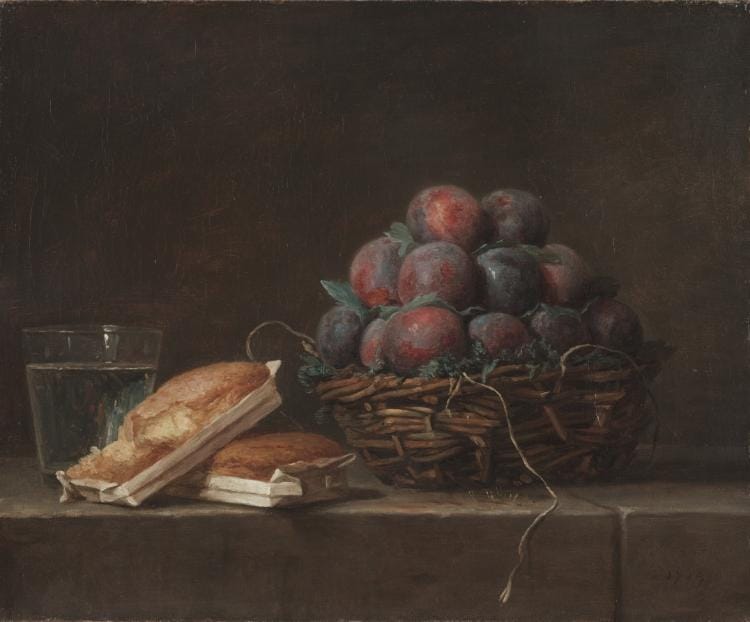
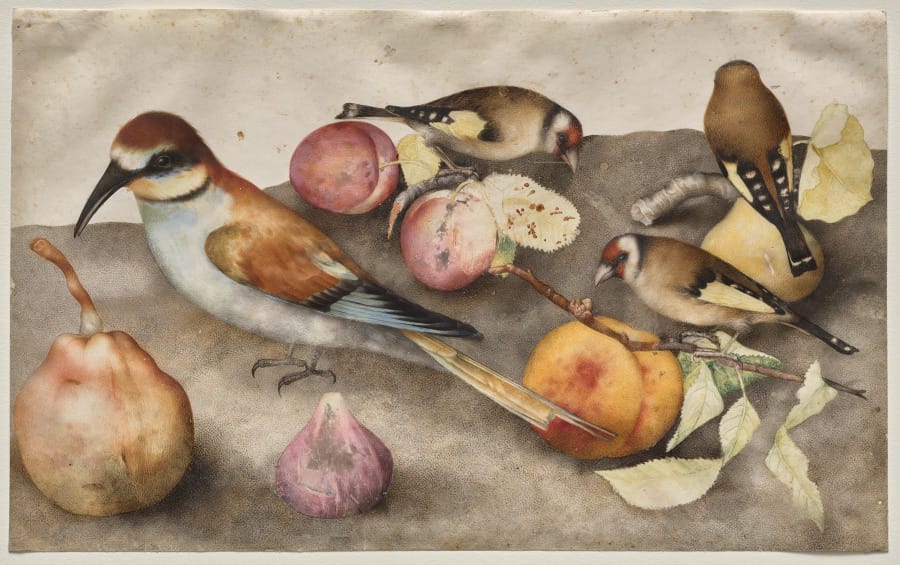
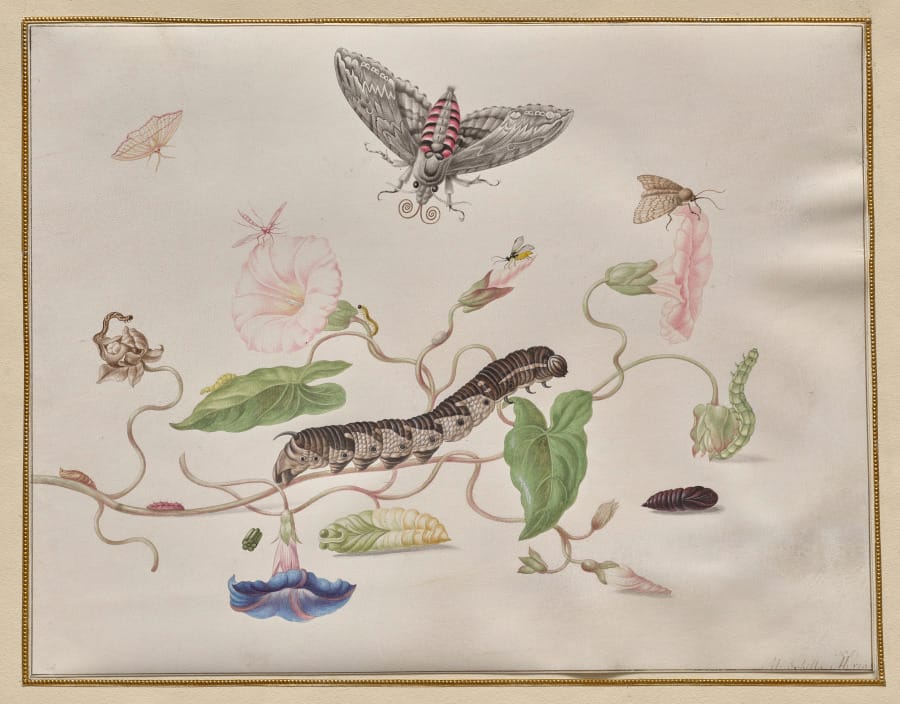
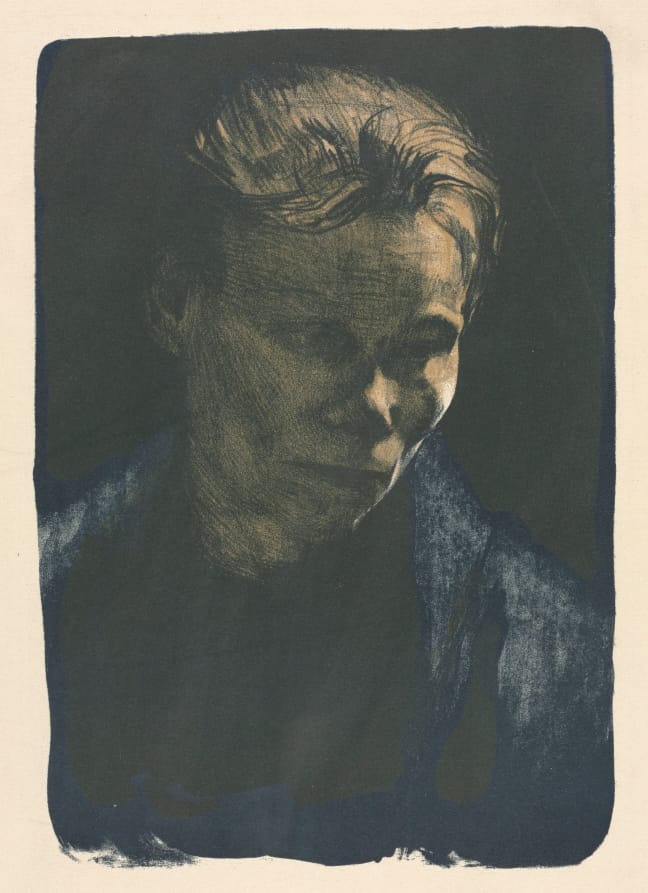
These images are from The Art Institute of Chicago and all text is adapted from the Institute’s website and/or Wikipedia.
Anne Vallayer-Coster was a French painter best known for still lifes. She achieved fame and recognition very early in her career, being admitted to the Académie Royale de Peinture et de Sculpture in 1770, at the age of twenty-six. Marie Antoinette took a particular interest in her paintings.
§§§
Giovanna Garzoni was one of the few women artists to achieve prominence in Italy during the 1600s, due to her naturalistic still lifes, which combined scientific accuracy with sensitive artistry. Her paintings attracted attention from aristocratic patrons like the Medici family, who acquired her drawings to decorate their villas.
§§§
Maria Sibylla Merian was a German-Dutch entomologist, naturalist, and scientific illustrator whose work established that insects have a life cycle and do not appear by spontaneous generation.
§§§
Käthe Kollwitz favored printmaking because she saw it as a democratic medium, affordable and capable of reaching all social classes. Kollwitz was the first woman not only to be elected to the Prussian Academy of Arts but also to receive honorary professor status.
§§§
§§§
§§§
I was speaking to a colleague in the hallway near the mailroom in my department, when I got a call from my wife.
“Where are you?” she wanted to know.
“I’m in Bradley Hall,” I said.
“Are you sure?” She sounded like she really didn’t believe me.
“Yes,” I responded. “I’m standing here speaking with—“ and I said the name of my colleague.
She asked me one or two more times if I was sure I was speaking to her from Bradley Hall, and when she was finally satisfied that I was, she told me that she’d just gotten a call from a doctor at a psychiatric ward in the Bronx. He told her that I’d had a psychotic break the night before and that I was now ready for her to pick me up. He didn’t believe her, she said, when she told him that the man he was talking about couldn’t be me since she’d seen me leave for work that morning with her own eyes. “What kind of a wife are you?” she said he asked her at one point, refusing to accept that my wife was not the wife of the man who’d been hospitalized.
It turned out that a man named Richard Newman who was indeed having a psychotic break had been brought the previous night to the hospital near where I live. I’d been to the emergency room there a few times, so when the person doing the intake typed Richard Newman into the hospital’s computer, along with that other Richard Newman’s birthday, which happened to be the same as mine, everyone just assumed they were admitting me. (That other Richard Newman did not have ID on him and they were unable to get from him the kind of information that would have differentiated us.) It took about two weeks to straighten everything out, including the fact that my insurance company had authorized and been billed for psychiatric services I neither needed nor received.
This was one of the strangest episodes in my life. Someone once suggested I ought to turn it into a short story or a novel, but my imagination doesn’t run in that direction. At some point, though, I would like to write more about it.
§§§
It’s not uncommon, of course, for students to develop crushes on their teachers. The first time I had that experience was during the 1984-85 academic year, when I was a graduate teaching assistant. A young woman sitting in the front row of my class kept repeatedly puckering her lips at me. I was so taken aback that the thought of being circumspect or even ignoring her never crossed my mind. I looked right at her and asked, “Are you blowing kisses at me?” She was so mortified, she never came back to class. The strangest experience I ever had along these lines, though, was some years later when a student who asked to see me told me she’d read some graffiti about me in the library that she thought I should know about. As soon as she sat down in my office, she showed me the page in her notebook on which she said she’d copied down what that student wrote. I wish I could remember the exact wording, but it was basically a woman’s expression of love, admiration, and desire for me. I didn’t know what else to say, so I thanked the student for bringing it to my attention and pointed out that, since I had no idea which student wrote it, or even if she was in one of my classes that semester, there was really nothing to say or do about it. The student took her notebook back and, without looking at me, asked if I would ever consider being with someone who wrote something like that. When I said no, she asked me why. I gave her the answers you would expect—she was my student; she was too young; and so on—but she kept pushing back until it became clear to me, and she finally admitted, that the profession of love had been hers and that she’d concocted the story about finding it in the library because she was afraid I wouldn’t even speak to her if she’d declared her love outright. Some people to whom I’ve told this story have said I should have told her the conversation was inappropriate and asked her to leave my office, and I did consider doing that, but the student was so clearly vulnerable, and her vulnerability so clearly had nothing to do with me personally, that I did not have the heart to shut her down so coldly. As we continued talking, she told me her story. Her father had left her and her mother in the country she was from ostensibly to establish himself so he could eventually bring them here, and this was why she’d decided to come to the United States for college. When she got here, though, she discovered that her father had, without divorcing her mother, married another woman and had children with her. He was, in other words, a bigamist. To make matters worse, he expected her to treat his second wife as if she were her mother, including calling her “Mom.” As you can imagine, my student, who was not more than nineteen- or twenty-years-old, was heartbroken, angry, and confused. “I hate men,” she told me several times as we talked, until she eventually brought the conversation back around to her profession of love for me and her conviction that we could somehow “make it work.” Age was just a number, she said; she would find a way to get around her father’s curfew when we wanted to go out; and on and on, until I finally said to her, “You told me you hate men, right?”
She nodded her head.
I looked her straight in the eye. “I’m a man, remember?”
I watched the realization dawn in her eyes. “That,” she smiled a little sadly, but also not without humor, “would be a problem.”
Eventually, she went back to her country. We corresponded every once in a while and I think I still have somewhere the pictures she sent me of the man she married and their children. This wasn’t the last time a student developed a crush on me, but it was a memorable one.
§§§
In 1972, after the signing of the Paris Peace Accords and the end of the Vietnam War, Congress ended the draft by allowing the president’s authority to induct men into the army under the Selective Service Act of 1948 to expire. I was ten years old. In 1980, the year I turned eighteen, in response to the Soviet invasion of Afghanistan, President Jimmy Carter reinstated Selective Service registration by signing Presidential Proclamation 4771. He wanted to make sure there would be a sufficiently large pool of available young men in case the United States had to respond to that invasion with a military action of its own. I became, in other words, old enough to vote and old enough to be sent to war in the same year. I’ve been thinking about this because I recently found a scan I made about ten years ago of the “Registration Change Acknowledgment” that the Selective Service System sent me in July of 1981. Someone had told me—I don’t remember who—that if I didn’t fill in my social security number on the original form the system had sent me, they would not be able to find me in the event of a draft. That I listened to this person shows both how naïve I was—the government had my address after all—and how desperate I was not to register. The thought that, for reasons having very little to do with me, my government might decide not just to force me to learn how to kill other human beings, but actually to do that killing, made me sick. I remember talking to my grandfather about maybe finding some way not to register. “You are,” he said, “an American, and you are a man, but most importantly you are my grandson. Of course you will register. Do not embarrass this family by doing otherwise.” I did not know where else to turn for support, and the form asking me to provide the information threatened legal action and a possible prison sentence if I didn’t give them my social security number, so I filled the form out and sent it in. I felt nauseous walking to the post office because I knew that once I dropped that form into the mailbox there was no going back. I would be cannon fodder, and the only question was whether or not my government would choose to put me in the line of fire. I am more than thankful, of course, that neither Jimmy Carter nor any other president during the years I would have been eligible found it necessary to reinstate the draft, even as they authorized military actions for which a draft might otherwise have been appropriate.
§§§
When my wife and I got married, we designed our own wedding ceremony, combining elements of Persian and Jewish culture in a way that reflected who we were individually and how we thought at the time about what it meant to bring our identities together in marriage. In place of traditional wedding vows, we each read a poem to the other. I chose a poem by Hafez from Hafez: Dance of Life, which I’d bought some years earlier. I liked the content of the poem, but not the translation—or, to be more accurate, I did not think either the prose translation by Wilberforce Clarke or the verse translation by Michael Boylan fit the occasion of a wedding, and so I made my own version, as they say, “after Hafez.” It is definitely not a translation. The notes to the poem say it is written on Hafez’ tomb. This is my version. I think it holds up pretty well after all these years:
Call me, and I will come. Heaven's bird,
from between the bars
of earth's closed cage,
I will come. Accept me as your own,
and my place in this world, and the place
held for me in the next, are forfeit,
for I will come.
Like rain for the earth,
bless me. Before the wind puts my dust
beyond the reach of your hand, touch me,
and I will come.
When I am dead,
bring song
and a bottle of good wine
to my tomb, stand
to your full height, a cypress
among ferns, and let the breeze
move you. To the fragrance
of your presence, dancing,
I will rise, clapping
I will come to you
with the rhythm of joy.
On the night of my old age, embrace me,
and in the morning, I will rise young.
On the day that I die, visit
for the space of one breath,
and, like Hafez, once more desiring
this life and the world,
I will rise. I will come.
You are receiving this newsletter either because you have expressed interest in my work or because you have signed up for the First Tuesdays mailing list. If you do not wish to receive it, simply click the Unsubscribe button below.
In a world that seems more and more troubled by disruption, It All Connects is where I work out for myself how to live in, with, and through the identities that define me.



Member discussion