Four by Four #59
Four Things To Read, Four Things To See, Four Things To Listen To, and Four Things About Me
The first thing I have to share with you is that I was interviewed by Charlie Finch on his Substack podcast called The Robot and The Flower. Unfortunately, I can’t embed the video, so you have to follow the link if you want to watch. It was a really good conversation, one of the very few in which I have been able to talk in a pretty seamless way about the connections between and among my experience of childhood sexual violence, the feminist roots of my healing, my politics, and my work as a writer. I even got to read a couple of poems! Charlie asks good questions and he knows when to let you talk so that the conversation takes the shape it needs to take. His podcast does come with a little bit of shtick, though: you doodle while you talk. Rather than try to draw either a flower or a robot, though, I decided to go back to my youth when one of my hobbies was to make mazes. The way I draw them, they always take quite a lot of time, though, so I did’t finish my podcast effort. I decided therefore to turn into...well, I don’t know exactly what you’d call it:
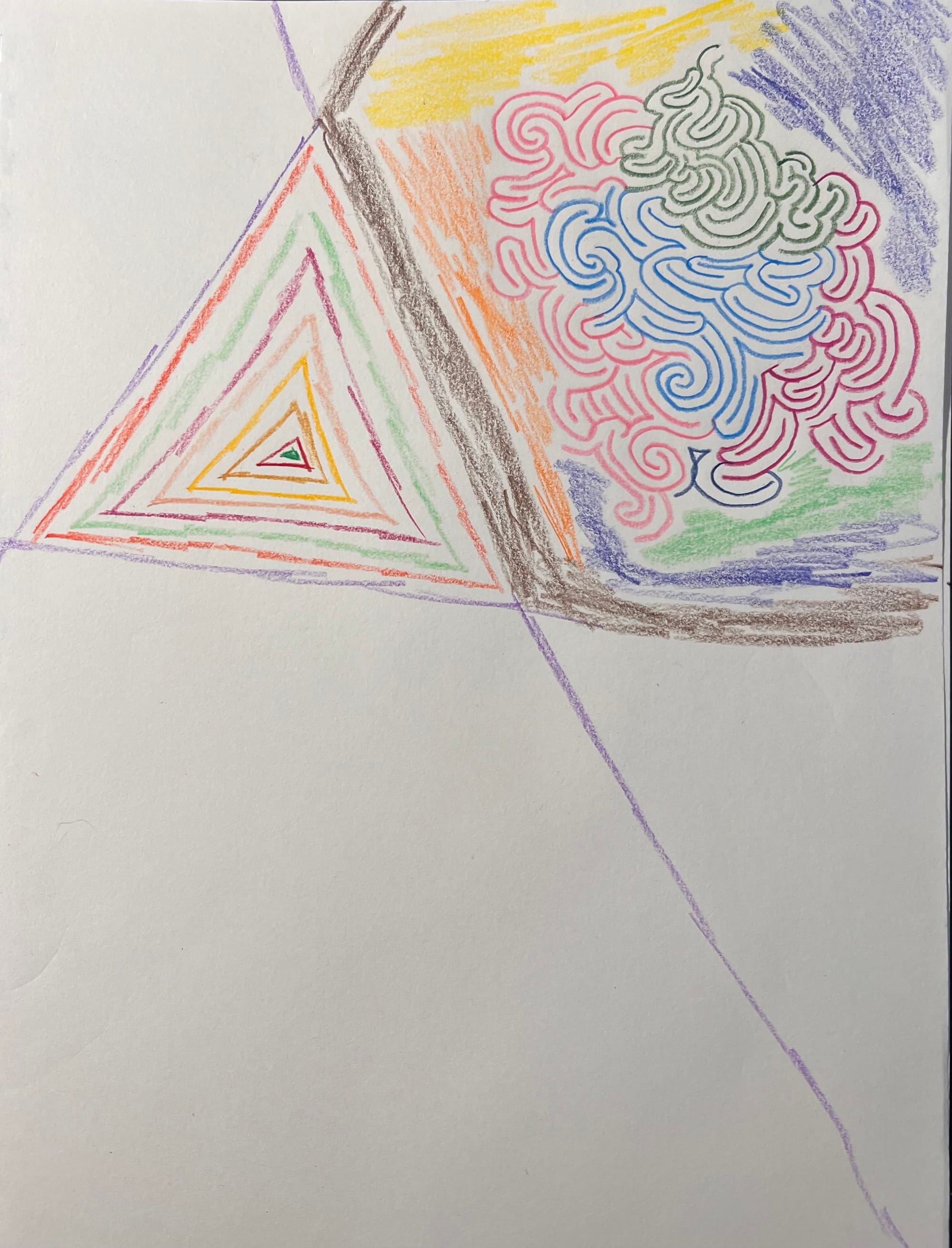
I do think I’m going to make some more mazes, though. It’s a relaxing, almost meditative activity.
The other news I have to share is that Lamberson Corona Press has published in anthology called Homaro: Perspectives on Human Rights and The Human Experience a prose piece called “The First Time I Really Understood What It Meant To Be A Man,” an excerpt from an as-yet-unpublished long essay of mine called “No Matter Where I Start, I End Up At A Point Of Origin I Did Not Choose.” My copies just arrived in the mail the other day, so this is hot off the press.
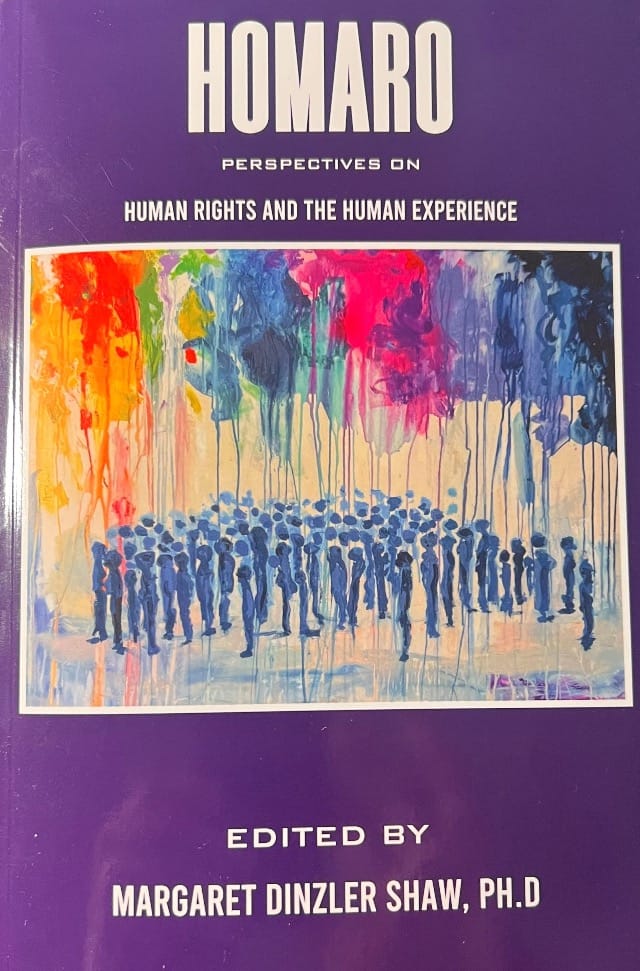
The book is available on Amazon and Barnes & Noble.
The Political Cage: Marjane Satrapi and the Burden of the Non-Western Memoir, by Mina Khanlarzadeh:
The double standard is clear. A Western memoirist is allowed to offer memory as literature: partial, emotional, shaped by rumor, fear, and childhood perception. A non-Western memoirist is asked for historical documentation instead, as if her memories were only legitimate once purged of uncertainty.
I tried teaching the first volume of Persepolis shortly after it was published and ran immediately into a problem I did not anticipate being as big as it was: my students’ lack of cultural and historical context. Not only did they know nothing about either the Islamic Revolution or Iranian culture; they were also spectacularly uninformed about Islam. They read Persepolis, in other words, through precisely the Western perspective that Khanlarzadeh critiques in this article, and they did so no matter how hard I worked to supply them with the contexts they were missing. Khanlarzadeh’s critique, however, is directed less at people like my students than at those who find fault with Satrapi’s memoir “for speaking from too narrow a position: a secular, upper-middle-class family affluent enough to send their daughter to Europe in the middle of the Iran-Iraq War.” Khanlarzadeh’s point is not that Persepolis is above criticism, but rather that there is a politics deserving of critique in the expectation that a memoir, which by definition is a writer’s attempt to capture a limited moment in time from within their limited perspective, is expected somehow to account for the entirety of the society in which they lived; and she finds in this expectation the double standard she articulates in the passage I quoted above. The article is worth reading for the way Khanlarzadeh incorporates a class analysis of this double standard into her critique, along with an analysis of the degree to which the phenomenon she is critiquing privileges without saying so the question of how Western readers will receive the work in question. I thought of two things as I read. The first was the controversy that surrounded Azar Nafisi’s Reading Lolita in Tehran. I’m not going to rehash all of that here, except to point out that one criticism lodged against Nafisi was that she used Western and not Iranian literature as the site of the resistance the book describes. I mention this because I remember attending a panel discussion around the time of that controversy and hearing Satrapi—she was one of the speakers—ask rhetorically whether it wasn’t just another kind of “provincial” and “totalitarian” thinking (and I believe those were the words she used) to declare Nafisi’s resistance illegitimate just because she located part of its source in Western literature. “Why is it wrong,” Satrapi asked, “for an Iranian woman to study and to love a writer like Nabokov?” The other thing I thought of as I read Khanlarzadeh’s article was what I learned about the early reception in English of Saadi of Shiraz, the way scholars at first assumed that everything he wrote in his Golestan, the works for which he is best known in the West, was autobiographically true, not the product of a literary imagination inventing what it needed to fulfill its artistic vision. They read him, in other words, through the same Western lens that Khanlarzadeh critiques—though she comes at it from a different angle—refusing to grant him in his Otherness the imaginative capacity to create literature.
§§§
The Rainbow of Hijab in Today’s Iran, by Naghmeh Sohrabi: I included more than a few of Sohrabi’s posts in the “Of Note” series I started shortly after Israel and the US attacked Iran. (This one is from March of this year.) She has been doing a real service by translating into English what Iranians in Iran are writing about their country, offering a welcome correction to the often slanted perception we have here based on the limited access we have to what Iranians have to say about themselves. This post translates a brief essay by Dr. Roya Khoshnevis about the reality of women’s relationship to the hijab in the wake of the 2022 Women, Life, Freedom movement that started in Iran after the death in custody of twenty-two-year-old Mahsa Jina Amini, who had been arrested for not wearing her hijab properly. Here in the States, we saw images of women bravely defying the law that required them to veil themselves and we read articles about how, through that defiance, women “won the right” to be in public with their hair uncovered. I put the phrase “won the right” in scare quotes, because they do not in fact have that right, at least not in legal terms. That reality is at the core of Dr. Khoshnevis article, which is worth reading:
[The] freedom [not to wear a hijab] has a ceiling. It exists on the street but not behind an office door. The moment a woman needs something official- a job, a degree, a bank account, or a seat on a plane, the freedom stops, and the veil goes back on, or the door stays closed.
Khoshnevis then describes two groups of women:
Dr. Khoshnevis’ essay opens a small, interesting, and important window into an aspect of what it’s (still) like for women in Iran to navigate the religiously authoritarian, patriarchal culture in which they live. Given not just the trend in this country towards a similar kind of authoritarianism, but the ways in which that authoritarianism is targeting women specifically, it’s worth paying attention to the reality this essay illuminates for us.
§§§
Requiem and Other Poems, by Aharon Shabtai, translated from Hebrew by Peter Cole:
But it wore him out
and he collapsed—
and lay there barely alive,
his head against the wall,
lazy flies
wandering across his bald spot,
and one particularly imprudent
large fly
indifferently
picking at his nose.
Since Israel began its devastating onslaught into Gaza, there has been a necessary, indispensable effort to amplify Palestinian voices, literary and otherwise. It is also, if differently, necessary and indispensable to pay attention to the Jewish and Israeli voices, literary and otherwise, working to come to terms not just with events since October 7, 2023, but also with the historical, political, and cultural context in which Israel and the Jews, both Israeli and not, are inescapably implicated. The poet Aharon Shabtai, whose work I did not know until I came across a review of Requiem and Other Poems, is one of those voices. Reading it, I found this statement from Publisher’s Weekly, quoted in the Poetry Foundation’s profile, to be apt: “His is ‘a voice mostly elided from American mappings of the Israel/Palestine question: acute, unblinking, unafraid to question, and aware of the stakes.’” The poem I have quoted from above, “Parable of the State,” is a devastating example, as it looks unflinchingly at what it costs to make cleansing your home of an Other your only and ultimate goal. It is only common sense that the discussion going on within Israel about “the Israel/Palestine question” is more complex than we in the United States usually hear about, even if that complexity does not now rise to the level of active popular resistance against the wars the Israeli government is prosecuting. I am not suggesting this one book of poems accounts for that complexity, though Peter Cole’s introduction suggests that the body of Shabtai’s work points in that direction. I am suggesting that grappling with “the Israel/Palestine question” should mean seeking out voices like Shabtai’s to place alongside the Palestinian voices so desperately in need of amplification.
§§§
When a Country is the Victim of a Blood Libel: From Anti-Antisemitism to Anti-Genocidism, by Shaul Magid:
Becoming a nation-state is a messy business, as Hannah Arendt and Hans Kohn among many others, taught us. The accumulation of power, and the exercise of power, especially over others in your midst, often leads to violence, stateless refugees, and easily results in a clash between morality (Kant’s “Perpetual Peace”) and what Germans call Machtpolitik. That is, states always hold the potential to become the primary standard by which all matters of justice is judged. Put otherwise, fascism is the occupational hazard of all states. That doesn’t mean Jews shouldn’t have one. It only means that a Jewish state is unlikely to avoid those same occupational hazards.
I appreciate the care with which Magid parses the question he investigates in this essay, not whether it is accurate to call Israel’s actions in Gaza a genocide—which he rightly points out is less a description of Israel’s actions than a legal decision about the category into which those actions fit—but rather what is behind the Jewish assertion, sometimes made only as subtext and certainly not by all Jews, that those actions cannot be a genocide and that the accusation of genocide is therefore a blood libel. At the heart of his argument is the dismantling of that logic. “In short, a blood libel is a horrible false accusation against a powerless minority by a powerful majority – church or state, whose intent was to rally the populace against the Jews.” Israel, he points out, is anything but powerless, and he goes on to show how, in assuming that power, Israel in fact turned the “Jewish Question” that gave rise to Zionism into the “Arab Question” to which the Netanyahu government has proposed the war in Gaza as the answer. It’s easy to dismiss writing like this as overly intellectualized given the very real, very immediate carnage in Gaza, but it’s important that there are thinkers like Magid doing this work. It’s an important antidote to the misleading propaganda and sloganeering that characterizes so much of what passes as critique and analysis these days.
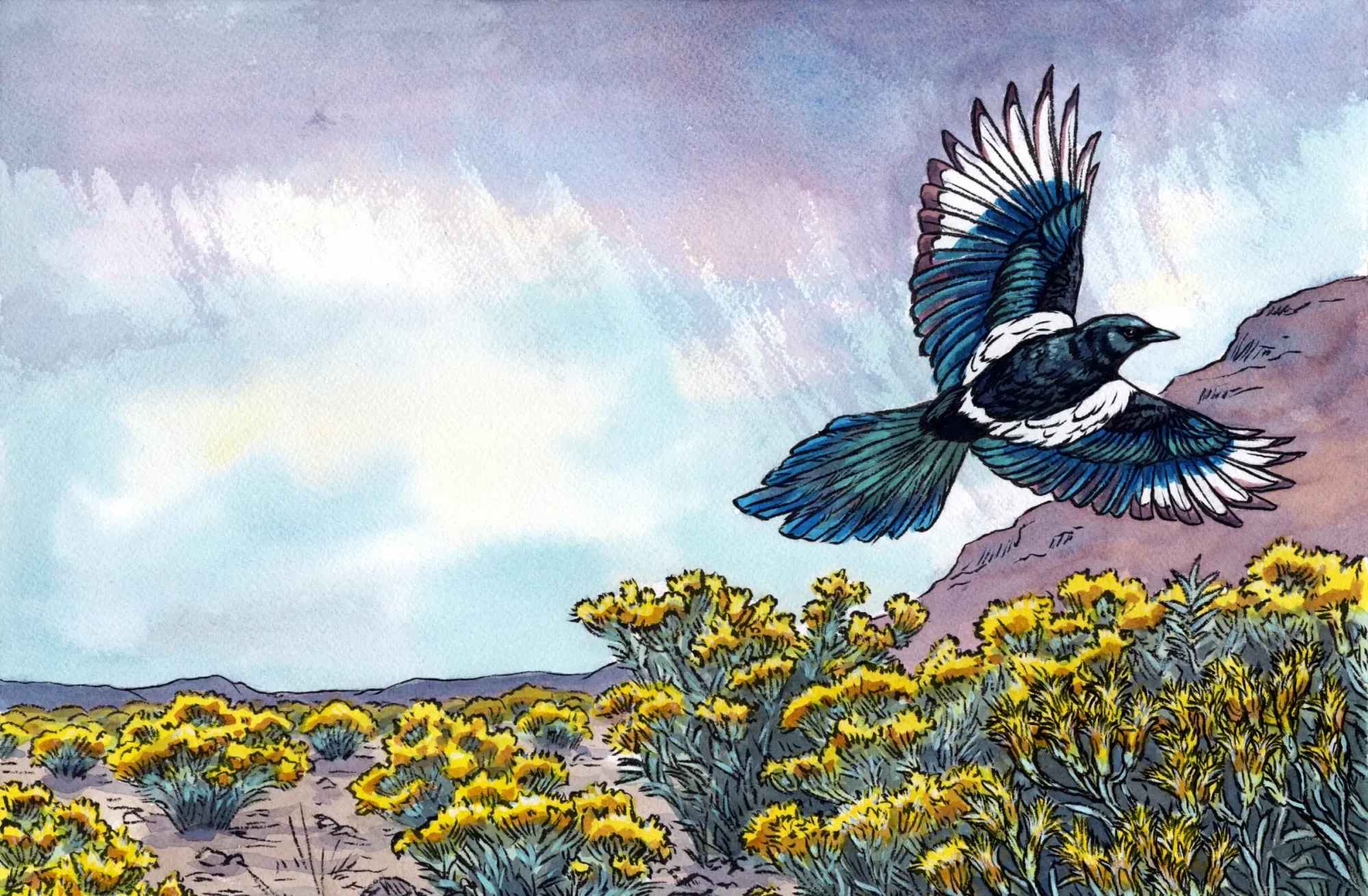
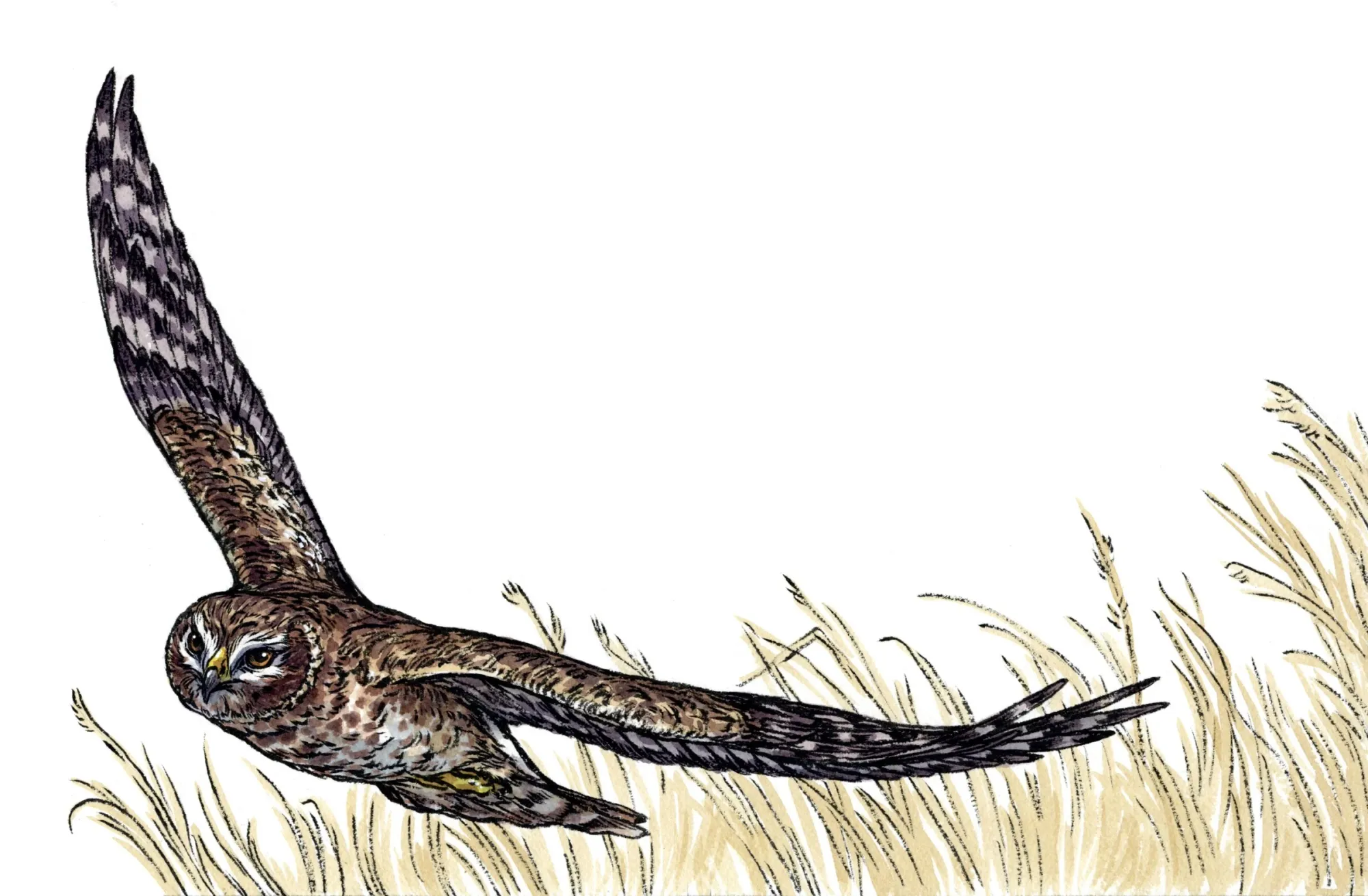
Emily Poole is an illustrator based in the Pacific Northwest. These two images are from an excerpt of her new book Cascade of Life that was published in Orion Magazine. I encourage you to read it.
Black-Billed Magpie | Pica hudsonia
§§§
Northern Harrier | Circus hudsonius
§§§
Moira Crone is a painter. The Chrysalis Series was published recently in Unlikely Stories. This is part of what she had to say about the series, taken from the Unlikely Stories website:
The sense in which the caterpillar retains its former memories even though it completely dissolves inside its cocoon, is one of the most remarkable mysteries in nature. Though so much about us changes in a lifetime, we remain ourselves...These works on paper are...based upon pictures of insects' evolution, with other notes of personal memory and reflection. The palette is consistent, but the mood in each piece is very different from the one before. Each phase can be traced to a portion of the inner and outer transformations I have experienced, and have seen in others--friends, children, grandchildren.
Foundling
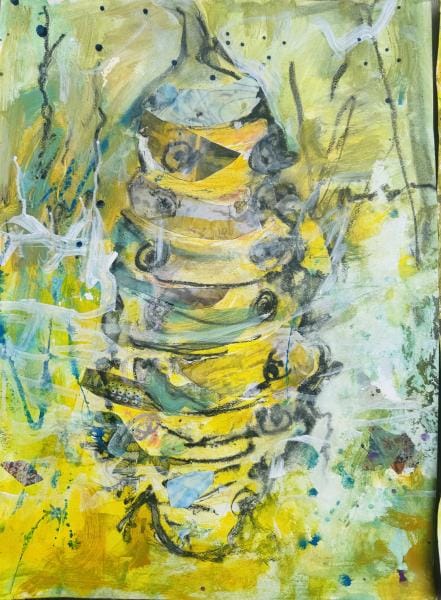
§§§
Flight
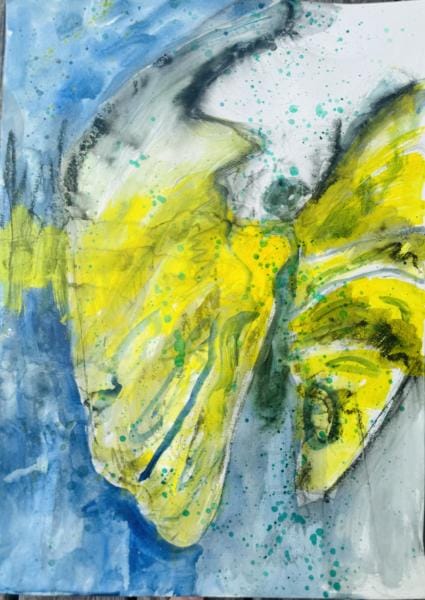
The daegum is a large, transverse, bamboo flute. Sanjo is a kind of traditional Korean music of which the Yi Saeng Gang style is exemplified in this recording. The drum is called the janggu.
§§§
§§§
§§§
Chahar Mezrab is a genre of traditional Persian music.
When I was a kid, we would always spend at least part of the summer at my grandparents’ house in Dutchess County. We called it “going up the country.” I remember catching garter snakes with my brother in the grass near the back porch and salamanders on my grandmother’s rock garden. Occasionally, we’d hold a toad in our hands for a few minutes before we let it go and, once or twice, we found a turtle making its slow, plodding way through the field my grandfather loved to mow. There are pictures of me throwing a frisbee across that field for one of the dogs we had over the years, and I think there’s somewhere a digitized version of the film my grandfather shot of the dog catching the flying disc. What started me thinking about this, though, was the birdwatching I used to do. My grandmother let me wear her binoculars around my neck as I walked the property, sometimes holding the book she told me I could use to identify the birds, sometimes not. I think I briefly have entertained the idea of becoming a serious birdwatcher, but nothing ever came of it. Still, I get a kick out of it when I am able to identify the once-in-a-while, out-of-the-ordinary birds I come across, like the red-winged blackbirds singing in the tree above our heads one summer when my wife and I stopped our bicycles to rest in its shade.
§§§
I don’t know if I ever wanted to be an astronaut when I was a boy, but I do remember wanting to be an astronomer. I remember a set of books with red spines and white hard covers, though I don’t remember what the set was called, and in it there were illustrations of the night sky at different times of the year, from the perspectives of both the northern and southern hemispheres. I also remember learning about the phases of the moon from these books, and about the possibility that there had once been life on Mars. It was the stars, the constellations, that most fascinated me, though. Back then—this would have been the early-to-mid 1970s—you could see a lot more of the stars in the city than you can now, and I remember standing by myself at night and tracing the shapes of the star signs that I’d been able to memorize. The first time I saw the Milky Way—it was summer and we were at the house in Dutchess County—I was speechless. I felt as if I became one with the endlessness of the sky—an endlessness that I somehow knew I only perceived because the stars seemed to be infinite. Being able to spend time under that kind of sky is one of the things I miss most these days.
§§§
I don’t remember how old I was when my mother and stepfather gave me a rainbow boa constrictor for my birthday, though I am sure it was after sixth grade. Mr. Baron, my sixth grade teacher, had a boa constrictor in the class and, as much because I idolized him as because I was fascinated with the snake, I wanted one for a pet. The snake only ate live prey, of course. So, once a month—thankfully the snake only ate once a month!—and weather permitting, I would ride my bicycle down Jericho Turnpike to the pet store where I could buy the mouse that would become Bowie’s monthly meal. The first month I had him, though, Bowie wouldn’t eat. I don’t remember who told me that the snake was probably getting used to his new home, but whoever it was also warned me not to leave the mouse unattended in Bowie’s tank for too long. As long as the snake remained unresponsive to the mouse’s presence, they said, the mouse could end up attacking and killing the snake. Now that I’ve typed that, it doesn’t really make much sense. No matter how much the snake might not care about the mouse’s presence, I couldn’t imagine it not responding if the mouse somehow touched it, especially if that touch were actually a bite. Nonetheless, that is what I was told, so I would put the mouse into the tank and watch. When it became clear that Bowie was not going to eat, I took the mouse out and put it back in its cage. I don’t know how many times I did this over how many days, but I grew attached to the mouse. I asked my mother if I could keep this one as a pet and go buy another one. She said no and so I kept putting the mouse in Bowie’s tank until once day I saw the snake stir and flick its tongue in and out, sensing the warm-blooded presence of a mammal small enough to be food. Then, in a movement fast that I could follow with my eyes, Bowie wrapped himself around the mouse—I think I’d started referring to it as Mousie—and I watched as he squeezed the small creature to death, unhinging his jaw so he could swallow it whole. For the rest of the month, I watched the bulge that had been the mouse move down the length of Bowie’s body until he shat out what his body couldn’t use, and didn’t need anyway, to sustain itself.
§§§
I also had an iguana at one point, though I don’t remember if Iggy came before or after Bowie. What I remember most about Iggy was feeding him lettuce and the way he would sit on my upper arm while I did my homework. I have no other memory of him.
You are receiving this newsletter either because you have expressed interest in my work or because you have signed up for the First Tuesdays mailing list. If you do not wish to receive it, simply click the Unsubscribe button below.
In a world that seems more and more troubled by disruption, It All Connects is where I work out for myself how to live in, with, and through the identities that define me.




Member discussion