Four by Four #61
Four Things To Read, Four Things To See, Four Things To Listen To, and Four Things About Me

Before Roe, by Ilana Panich-Linsman and Lauren Kelley:
Still, Roe’s demise will be shattering, and there is much work to do in preparing for it. One important part of that work is studying what came before…[W]e must remember the struggles of Americans who had abortions before the procedure was widely available—like the women photographed below, many of them telling their stories for the first time—because we will need to draw from their experiences in fighting back. Yes, a fight will be needed to regain access to abortion for millions once Roe is gone. And these women have waged that fight. They have waged it with their bodies. And they have the scars to prove it.
This article was obviously published before the Supreme Court struck Roe down—it got lost amidst all the other articles and essays I’ve archived to include in Four By Four—but the stories of the women included in the piece are worth reading again and again. I will let them speak for themselves.
§§§
On Gout, by Jan Steyn:
It can be the disease of kings, the disease of creoles, or, as Hippocrates had it, “the unwalkable disease.” It can signal a surplus of sexual appetite…or a deficit of sexual appetite. Gout is many things, depending on the source: a form of arthritis; a crystallization of excess — of legacy, of temperament; a benevolent companion alert to poor choices; a distillation of bad fluids into joint-bound droplets — gouttes, in French, guttae in Latin. It can be a righteous comeuppance, or an impartial sentence, afflicting glutton and ascetic alike. By nearly all accounts, it is more prevalent among the aged, and the sedentary; wherever it appears, pain follows. But if there is another truth just as persistent, it is that these shared features never outweigh the local variations — how every culture translates gout into its own moral, medical, and linguistic idiom.
I vividly remember my first gout attack, how my ankle swelled to the point where I couldn’t put any pressure on it and I actually crawled on my hands and knees to get around the house until someone, my wife I think, got me a cane I could use; and I remember how fragile and vulnerable I felt as even with the cane I had to limp and hop across the street to get to the doctor’s office. He diagnosed me in a matter of minutes, prescribed colchicine and allopurinol, the standard drug treatments for gout. Unfortunately, I broke out in hives shortly after taking the allopurinol, and so, not wanting to risk the possibility that I was reacting to the drug, I embarked on a journey of alternative methods for managing the disease, focused mostly on a change in diet. This worked with varying degrees of success until the disease progressed to the point where I had no choice but to go back on allopurinol, though my new doctor suggested we try a lower dosage at first. When I did not break out in hives, I stayed on the lower dosage until I started having attacks again and it became clear that I needed to take the full dose, which I did. I have not had an attack since. At no point in this journey, however, was my gout as severe as Steyn’s and so I never felt the need to integrate my experience of it into how I gave meaning to my work and my life as he has done in this piece. I was particularly taken with the connection he makes between gout and his work as a literary translator:
Gout…is a master translator…She takes what the body offers—last week’s wine, last year’s weight gain, yesterday’s skipped meds—and translates it into her own idiom. A twinge in the ankle. A stabbing pain in the wrist. A flare-up in the joint you most require this week. She responds not only to the known variables—diet, medication, sleep—but to the hidden ones: stress, trauma, weather, mood. She works across the whole text of the body, moving phrases around, altering emphasis, striking a balance visible only in hindsight. Like a gifted milonga dancer adapting to the irregularities of an unfamiliar cobblestone path, she makes it look smooth—but to the sufferer caught in the performance, it feels less like grace and more like chaos. In retrospect, the logic may be clear. But in the moment, it bewilders. Like translation, Gout teaches its lessons after the fact, often in a language as yet inaccessible, and with a grammar learned only by limping.
This essay is a moving example of someone making meaning from their own suffering in order to find a way not just to live with it, but to transform it into something that, while it might not eliminate the suffering, definitely transcends it.
§§§
Defeating Zionism to Free Palestine, by Noura Erakat and John Reynolds:
We see part of our task now as one of continuing to build on the recent “mainstreaming” of condemnations of Israeli apartheid and genocide, but in a way that decisively resists the drift toward narrower, liberal articulations and insists on the importance of radical, anti-colonial, and anti-imperial analysis and praxis…We argue that while legal actions should be pursued in the service of political and social movements, legal logic is insufficient in itself — and can risk narrowing or distorting the horizon of Palestinian liberation. In our view, the proliferating condemnations of Israel by major human rights organizations and mainstream figures in recent years have belatedly reflected the popular consensus and a political reality that Palestinian activism had made undeniable. They also fit, to varying degrees, within a wider pattern of containment.
I am by nature suspicious of totalizing statements like the one that serves as subtitle to this article: “Palestinian liberation is the key to fighting racism, imperialism, and genocide around the globe.” It’s not that I think Palestinian liberation is unconnected to the struggles against “racism, imperialism, and genocide around the globe,” but rather that I find this kind of unipolar formulation to be inevitably reductive, maybe not in intent, but all too often in effect. That said, I found Erakat’s and Reynolds’ essay, adapted from their book Confronting Zionism, provocative in important ways, especially the assertion that the “domestication of racism in international law...has obscured [racism’s] relationship to global capitalism and transformed it into a problem for individual countries to resolve through juridicial reform or diversity, equity, and inclusion programs.” Erakat and Reynolds argue that to treat racism, simply, as the manifestation of a hatred that can be overcome in isolation from its connection to the larger socioeconomic inequities inherent in capitalism, colonialism, and imperialism is, in the end, to perpetuate those inequities. This essay does not explicitly martial the evidence to demonstrate how this applies to Zionism, Israel, and the Palestinians—you need to follow the links to get that and/or, I imagine, read their book—but if you’ve been following what’s been going on in Israel, even if only since October 7, 2023, it’s difficult to argue that the argument should not be taken seriously. I will confess that I still cringe inwardly when Zionism is defined as “a colonial project in Palestine,” with everything else that phrase implies, not because I think the definition is wrong, but because I am all too familiar in my personal life with the way that line of reasoning can lead people to use Zionist as an epithet, not unlike the way “commie-pinko-fag” was an epithet when I was younger; and I know, also from experience, that when Zionist becomes an epithet, the anti-Zionism it expresses is more often that not very thinly veiled antisemitism. Nonetheless, if I set that concern aside, as I think it is useful to do when discussing Israel and Palestine in good faith with people whom I believe intend their critique in good faith, the points the writers of this essay make are necessary ones to wrestle with. I also think it’s worth reading this brief essay, and, I also imagine, the book it is adapted from, next to the essay Toward Nakba as a Legal Concept, by Rabea Eghbariah.
§§§
Chapter Eight from A Taste of Bitter Tea, by Mohammad Alnaas (translated by Nashwa Nasreldin):
The restive young men continued to meet every day as usual, just before noon, to discuss the feud. Their self-appointed storyteller had informed them that a little birdie had whispered to him what a cat had told her, which another cat had passed on, which she’d heard from a third cat who had been spying on some locals’ kitchens. And that was that the colonel’s family had, for an entire week, been enjoying a lavish fish meal – every single day, with each dish more elaborate than the last. There was no doubting the other animals’ testimonies, all of them being naturally trustworthy, since animals have no capacity for cunning nor brains capable of concocting lies. The storyteller also added that our hero – the hero of this tale who we may not meet until the very end – was rallying the people of his own village, to help the dear sons of Jahannam reap double the vengeance. Now this is precisely what we would call: ‘external interference in our private affairs.’ Which is totally unacceptable of course, since we must always protect our land from the enemy, no matter how much we may hate each other, and no matter how much we may also hate the village.
Alnaas is a Libyan writer. In 2022, he was awarded the International Prize for Arabic Fiction for his novel Khoobz ‘ala Tawila al-Khal Milad, which was published in English in 2024 as Bread on Uncle Milad’s Table, translated by Sawad Hussain. “A Taste of Bitter Tea” is borrowed from the title of the novella’s French translation by Sarah Rolfo. (Another excerpt, translated by Rana Asfour, can be found here.) I chose the above excerpt because it gives you a flavor of the political and cultural complexity that the narrator, tongue planted firmly in cheek, maps out for you. I’m not going to say more than that. Please go read the excerpt for yourself. I think you’ll agree with me that Alnaas is a writer worth knowing about.
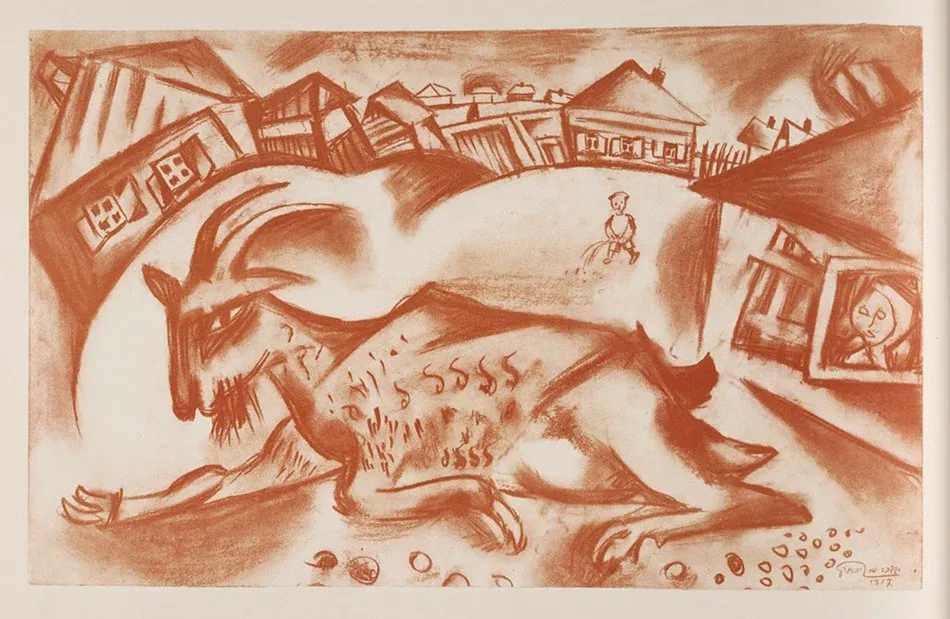
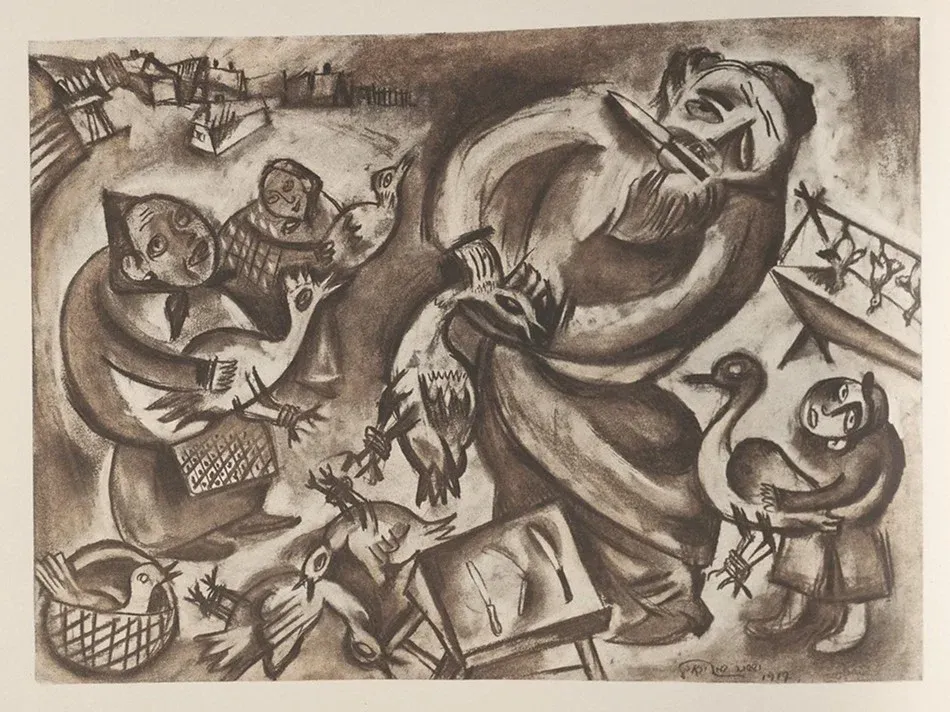
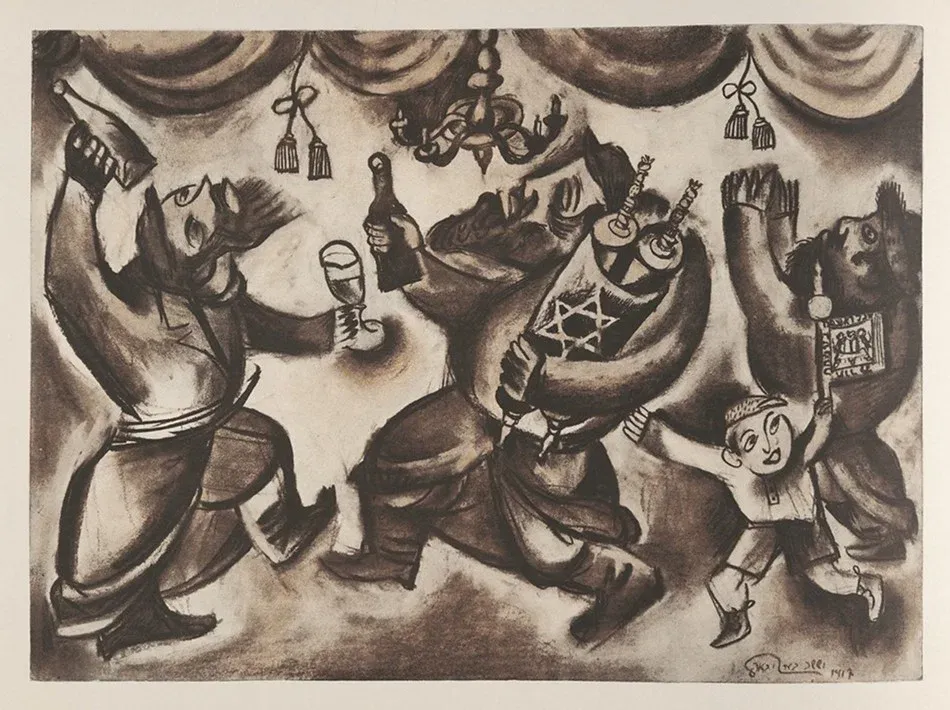
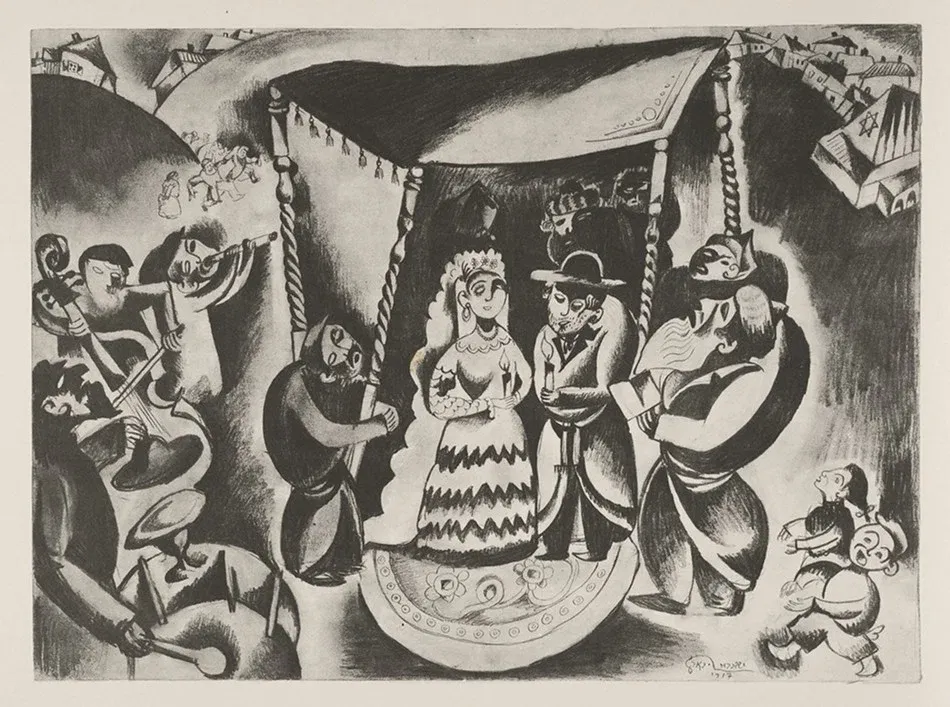
These images, taken from the Public Domain Review (PDR), are of lithographs by the Russian artist Issachar Ber Ryback. Dating from around 1917, they were published in a book by the Berlin-based publishing house “Farlag Shveln,” which was known for avant-garde illustrated Yiddish books. These four, taken from a set of thirty, depict scenes from everyday life in Ryback's home village in Ukraine, before it was destroyed in the pogroms following World War I. Ryback graduated from art school in Kiev in 1916 ands went on to play a key role in the Yiddish avant-garde of the Soviet Union following the Russian Revolution. After his father was murdered by Petliura’s soldiers in 1921, he fled to Germany, settling in Berlin where he became a member of the Novembergruppe and was involved in a number of important exhibitions. After a return trip to Russia, working on a set design for a Yiddish theatre and undertaking a prolonged journey through the Jewish “kolkhozes”—collective farms—of Ukraine and Crimea, he moved to Paris in 1926, where he died in 1935. (Text adapted from the PDR website.)
§§§
§§§
§§§
§§§
§§§
§§§
§§§
The yeshiva high school I went to graduated students with a high school diploma in eleventh grade. I don’t remember exactly how they did that, but somehow we all ended up with enough credits that we could’ve skipped twelfth grade if we wanted to. The yeshiva presented us with two options. Either we could go to Israel and learn Torah there for a year before starting college or we could register for an early admission program they’d created with the college across the street. If we chose that program, we would continue to learn Torah in the morning, just as we’d been doing in high school, and then take college classes in the afternoon, giving us a head start on the rest of our education. I had no desire to go to Israel, especially not to attend an all boys orthodox yeshiva, and no real desire to start college early, a concept that didn’t make much sense to me since I didn’t see figuring out what I wanted to do with my life as a competition. If I’m completely honest, though, and this is a story for another time, I also wanted to be out of the yeshiva environment. So I went back to public school for twelfth grade. I knew some of my classmates from when we were in elementary school together and they remembered me as one of the top students in the class. I found out later, speaking of competition, that there were among them those who feared I would somehow manage to become class valedictorian and that some of those classmates only started speaking to me after they found out that my grades did not place me at the top of the class.
§§§
As I sit typing this, I am aware of the ache in my arms and chest from having worked out yesterday. The first time I lifted weights was with a boy in my neighborhood named Don. Don and I were the same age, though he went to one of the Catholic schools in the area—I believe it was called Maria Regina. I was still in public school, which meant we were in seventh grade. I don’t remember how we met, but I have a clear summer memory of Don bringing his benchpress out from the garage and into the driveway. Maybe we were showing off, but, to be honest, that’s not the feeling that attaches itself to the image in my mind, which is more about not wanting to get all sweated up in the garage. I liked Don a lot, but, sadly, he was killed by a hit and run driver about a year after we met. I remember him very fondly, and I am sure that the pleasure I get from lifting even now is connected to my friendship with him.
§§§
When I was a kid, we had a Weimaraner named Cindy. I don’t remember under what circumstances she became pregnant, but just before she gave birth, she climbed into my bed to sit next to me. I don’t have much else to say about this memory right now, but it is a tender one that I cherish.
§§§
As you know from some of the things I’ve written about, I’ve been reading through my old journals. In the one I kept in 1986, in an entry dated October 8th, almost exactly forty years ago, I found this unrhymed sonnet that I called “Improvisation on Some Lines of Ovid.” I have no memory of reading Ovid or of what moved me to write this poem, and I have not gone back to check how much this poem deviates from the original, which is in Book 1 of The Art of Love, but reading these lines over now, I like them. I’m not sure they stand on their own, but I like them:
If there is one who lacks the lover’s art
and he lives among you, provide for him
this book. My words will fill his hands and lips
as the ocean wind fills a vessel’s sail;
and as a captain learns to judge the sea
by how the current takes his ship, the man
who reads this book—if well—will learn in love
that sailor’s patient skill. No oracle
has prompted me to this. No muse has urged
my hand. To teach I must remove myself
from what is taught, must make myself immune
to love, and so, unhindered, show the way.
I write as one man, simple, to another,
a trusted friend. There is no crime in that.
You are receiving this newsletter either because you have expressed interest in my work or because you have signed up for the First Tuesdays mailing list. If you do not wish to receive it, simply click the Unsubscribe button below.
In a world that seems more and more troubled by disruption, It All Connects is where I work out for myself how to live in, with, and through the identities that define me.



Member discussion