On The Trail of a Tail - Part Three: Crossing The Border from Iran to Europe
[T]ranslation as the performance of centrality—in this case of a Christian centrality—that emerges from and serves to perpetuate real political power and that is therefore both demonstrably false and inherently harmful.
I originally scheduled this post before Israel and the United States went to war with Iran. I thought of it then as making visible a historical connection between Iran and the West that is worth knowing about. Now, while I think it is too much to claim the label of resistance for this series, since it will have less than zero impact on the war, I do believe the war has made it necessary for people on both sides, but especially in the United States, to know about this connection. For that reason, I have removed the paywall from the entire series. I hope you find it enlightening.
In Part Two of this series—you can read Part One here—I traced the source of Benjamin Franklin’s Parable Against Persecution back to two seventeenth century Christian arguments for religious tolerance, Jeremy Taylor’s plea in Discourse of the Liberty of Prophesying for Christians of different denominations to stop persecuting each other and George Gentius’ petition for a more tolerant treatment of the Jews in the epistolary introduction he wrote to Historica Judaica, his Latin translation of Shevet Yehudah. In Part Three, I want first to trace the story’s origin back to the 13th century Persian poet Saadi of Shiraz and, second, to tell you about how Saadi’s work entered European culture in the first place.
Who Was Saadi of Shiraz?
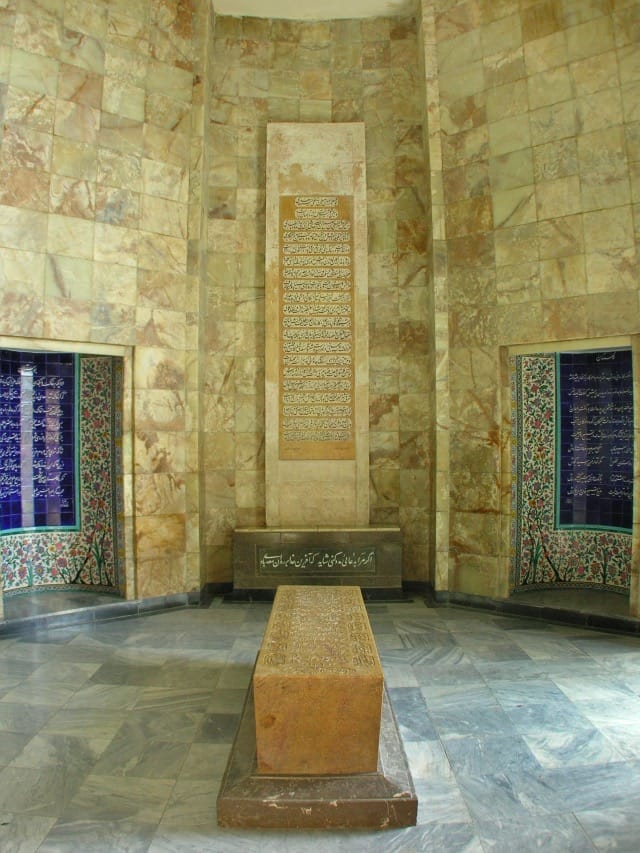
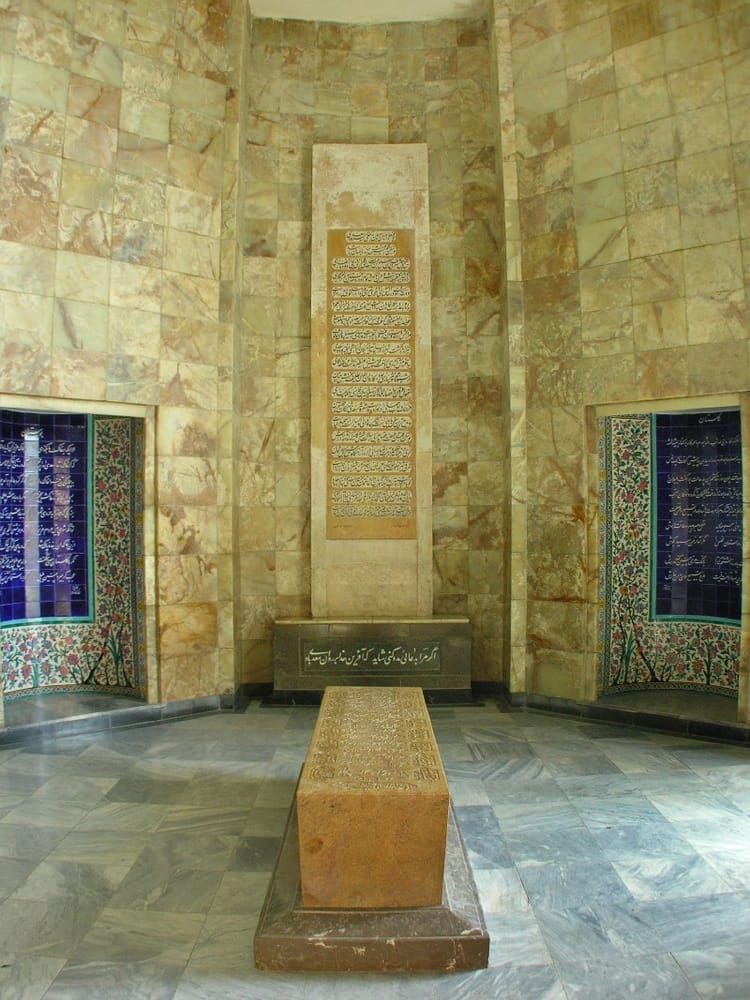
Saadi is the pen name of one of the luminaries of the Persian literary canon, roughly equivalent in reputation and cultural significance to Shakespeare in English. You can get a sense of his importance by the way his verses are inscribed and engraved throughout his tomb.
Saadi’s precise given name is not known for sure. Sometimes he is called Muslih al-din and sometimes Mushariff al-din, an uncertainty which corresponds neatly to the fact that we can say very little with absolute confidence about the details of his life. The scholar Homa Katouzian, for example, after a good deal of literary and historical sleuthing in Saʿdi: The Poet of Life, Love and Compassion, manages to place the poet’s birth around 1208 and his death somewhere between 1280 and 1294 respectively, but that’s as precise as he was able to get. The only things we can say for certain, Katouzian argues, aside from the fact that Saadi1 lived and wrote in the 13th century, is that he attended the Nezamieh College in Baghdad and that he traveled, though how far and how widely has long been a matter of scholarly debate.
Traditionally, Saadi’s biography is divided into three parts. I’ve just mentioned the first two, education and travel, while the third is the period from 1256 to his death, during which he wrote the works for which he is best known outside of Iran, Golestan (Rose Garden) and Bustan (Orchard).Bustan contains the story that became Benjamin Franklin’s Parable Against Persecution, which I will from now on refer to as the story of Abraham and the Zoroastrian. I will have more to say about both these texts below, but given how important and influential those books have been outside of Iran, it’s worth pausing for a moment to consider how widely famous Saadi was in his own time. In Beholding Beauty: Saʿdi of Shiraz and the Aesthetics of Desire in Medieval Persian Poetry, Domenico Ingenito offers a political explanation for how that fame might have spread. He suggests that the gratitude and loyalty Haulagu Khan felt he owed the family of Saadi’s patrons for their assistance in the sacking of Baghdad— which he showed by making Saʿd II, one of Saadi’s direct benefactors, heir apparent to the Fars region of Iran—carried over by association onto Saadi himself and that this loyalty helped spread Saadi’s name throughout the Mongol empire. Katouzian offers a specific example, citing a reference in The Travels of Ibn Battuta to singers in China who, shortly after Saadi’s death, performed one of his lyrics even though they did not know what it meant.
Another measure of the esteem in which Saadi’s work was held long before it made its way into the European imagination can be taken from the apocryphal tales people told about the poet. Gore Ouesely, for example, in Biographical Notices of Persian Poets, relates a story in which a man dressed as a wood-cutter planned to steal food from a basket of leftovers that Saadi regularly hung outside his window for the benefit of the poor of Shiraz. As soon as the thief reached for the food, however, his arm dried up and withered. The man decided that Saadi himself must have caused this miraculous thing to happen and called out to the poet for help. Saadi responded by asking the man why, if he was a woodcutter, his hands showed no signs of manual labor; and, if he was a thief, why he did not have with him a thief’s tools or behave with the hardened mannerisms of a criminal. Nonetheless, Saadi had mercy on the man, restoring his arm with a prayer and giving him some food to send him on his way.
In another story, this one related by Hamid Dabashi in The World of Persian Literary Humanism, Saadi is summoned to the court of Abaqa Khan, who asks the poet at the end of his visit for advice. Saadi tells the Khan that he only needs to remember one thing: “You cannot take anything from this world to the next except the consequences of good and bad deeds. Now, you do as you wish.” When the Sultan asks Saadi for a poem expressing this idea, Saadi, in Dabsahi’s translation, extemporizes: 3
A king who attends to the well-being of his subjects Deserves the taxes he collects, for they are like the wages that a shepherd receives. And if he were not to attend to the needs of his subjects, May that wealth be like poison to him for he is abusing Muslims.
Upon hearing this, the king bursts into tears, fearing that he fits the description in the second couplet. When he asks Saadi to tell him which kind of king he is, Saadi answers: “If you are like the king in the first couplet, then you are; if not, you are like the other one.”
While it is highly unlikely that a poet’s words could so easily reduce a king to tears, what apocryphal tales like these show is that people created an imagined version of Saadi as a proxy for how they believed the moral sense they found in his work should function in the world. What we would call the humanism by which that moral sense is informed is what attracted the medieval European thinkers who first translated Saadi, and the degree to which that humanism has continued to speak to the people of the world is evidenced by the number of languages into which Golestan, Saadi’s most famous work, has been translated. That list currently includes English, Urdu, Russian, Italian, Polish, Provençal, Hindi, Romanian, Czech, Turkish, Arabic, Japanese, and Chinese.
How Did Saadi’s Work Find Its Way To Europe?
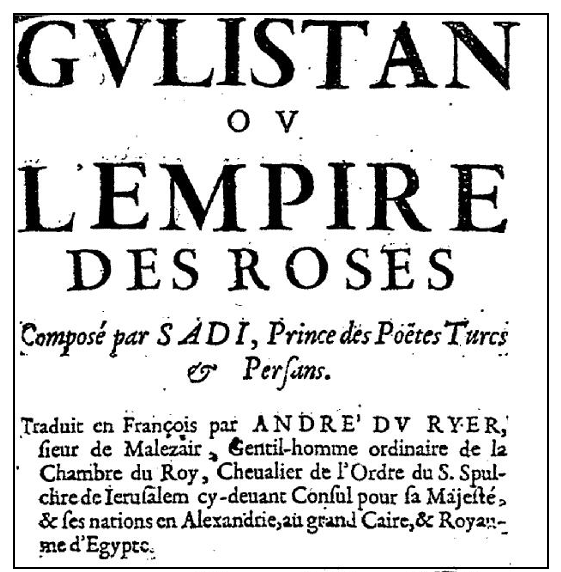
While Saadi’s stories were not entirely unknown in the Christian west prior to the 17th century, when Gentius and Jeremy Taylor used his story about Abraham and the Zoroastrian for their own purposes—and while it’s possible that stories like the apocryphal ones I told you above were known there as well—historians date what you might call Saadi’s formal entry into the Christian imaginary to Andre du Ryer’s partial French translation of Golestan in 1634. An important French diplomat and a scholar of Arabic and Persian, du Ryer likely came to know Golestan precisely because of Saadi’s immense popularity. He produced his translation, L’Empire Des Roses on his return to France after negotiating terms of commerce with the Persian Empire as King Louis XIII’s Secretary-Interpreter for Oriental Languages.
In a way, du Ryer can be understood as one of Gentius’ intellectual forebears. Like Gentius in his stance towards Judaism, du Ryer took Islam seriously on its own terms as an ethical and intellectual system, which was not without risk in a context where even appearing to question Christianity as the one true religion could result in your being branded a heretic. So, even though it is clear that du Ryer translated Golestan because he recognized its literary—he praised Saadi’s work for “the solidity of its discourse, the sweetness of its poetry, and the gravity of its maxims” and called Saadi a “Prince of Turkish and Persian Poets”—a careful reading of the epistolary dedication du Ryer wrote for his translation shows him navigating the political and religious pressures he knew would be brought to bear once it was published.4
Du Ryer very deliberately chose Antoine Hotman as his dedicatee, for example, because, as Hotman’s titles make clear—“lord of Morfontaine, Abbot of Saint-Mard, Counselor to the King in his Court of Parliament”—he had the political, judicial, and ecclesiastical authority to declare L’Empire Des Roses non-heretical. In particular, du Ryer praises Hotman’s role as a patron of “Oriental Christian scholarship,” in particular his sponsorship and protection of Gabriel Sionita, who was working at the time on the Syriac portion of the Paris Polyglot bible. Only after placing his own work within that legitimizing genealogy, does du Ryer dare to frame his translation of Saadi as something worthy of a similar kind of support, asserting that, despite its roots in Islam, Saadi’s work contained nothing that would “offend [even] the most scrupulous” of Christian readers, while arguing without actually saying so that those readers would find Saadi’s text useful in their own lives.
The need to provide that kind of reassurance to a religious political power structure no doubt also explains why Gentius felt it necessary to revise Saadi’s story to include the Zoroastrian’s conversion to Christianity (see Part Two); and while Jeremy Taylor did not in his project cross religious lines in the same way that Gentius and du Ryer did, it’s clear that he must have felt an analogous pressure. Otherwise, why take an entire book just to propose, in essence, that all Christian denominations were “created equally?” Saadi, clearly feeling a similar need to reassure his patrons that his books were religiously appropriate, began each of his books with invocation of Allah’s and therefore Islam’s supremacy. At the same time, however, he seems to have been confident enough in his own standing that he was willing to risk being critical of the religiosity those in power in ways that his Christian interlocutors were not.
Saadi’s Bustan and Golestan: A Brief Overview
As I said above, the story of Abraham and the Zoroastrian comes not from Golestan, which Saadi completed in 1258, but from Bustan, which he finished the year before in 1257. The contrast between the books is quite stark. In style, genre, and content, Bustan is clearly intended for the people of the court. It is composed entirely in verse and includes literary and historical references that would have required for their understanding the kind of education that only the highest social classes would have had available to them. The story of Abraham and the Zoroastrian might not seem like a such a story at first, since even an illiterate Muslim would likely have known who Abraham was, and, at least on its surface, the point of the narrative seems to be, simply, that we should be kind to strangers, even those who are radically different from us. Saadi’s comment on the narrative, however, in which he suggests that a non-Muslim’s commitment to his own religion might be worthy of respect would almost certainly be walking a line similar to the one that du Ryer and Gentius each walked in their own time. (I spell out this explication of Saadi’s story in Part Two.)
Moreover, since Bustan is best understood as a work of didactic literature directed at those with political power, the entire book can be understood as an exercise in telling them the truth about how they should conduct themselves. In this context, the story about Abraham and the Zoroastrian can be seen as an example of something Saadi does throughout both Bustan and Golestan: speaking truth to power. Still, it’s one thing to speak that truth and tell such stories among the ruling elite, where intellectual debate, subtlety and nuance, and even a certain level of disagreement are tolerated and perhaps even encouraged, if only for their entertainment value. It’s quite something else to tell those kinds of stories and speak those kinds of truths among the subjects of those same rulers, yet Saadi makes clear in his introduction to Golestan that those are the people for whom that book is intended.
In relating the narrative of how he came to write Golestan, Saadi responds to the “roses, sweet basil, hyacinth and other fragrant herbs” that a friend he’d been in conversation with had gathered by saying, “You know the season holds no loyalty to its fruit…The roses will wither and die. As the wise men warn us: ‘Do not cherish that which does not last.’” On the surface, this would seem to be a conventional comment on the fleeting nature of the physical world and of the cuttings his friend had gathered, but it could also be read to apply to the ephemeral nature of words, a metaphorical reading that the next part of the story would seem to substantiate. Saadi’s friend asks him in response, “What should we do then?” Saadi answer—“I will write a book to instruct and amuse the people, a golestan, a rose garden, whose petals will not fall away at the touch of autumn’s wind, and in which it will always be spring, immune to the passing of time”—makes clear that he doesn’t believe the “roses of wisdom” his stories contain should be shared only with his royal patrons and their court attendants.
Regardless of whether this metaphorical reading is accurate, it is nonetheless true that Saadi wrote Golestan to be accessible in ways that Bustan is not. To begin with, Golestan is what we today would call a hybrid text, combining prose and poetry in ways that are intended to heighten both humor and poignancy for a general audience; the level of diction is clearly not as high minded as in Bustan; and the characters in the Golestan tend to be anonymous, requiring no specialized historical knowledge to understand. Whether that accessibility is why du Ryer chose to translate Golestan rather than Bustan is impossible to know. Since Golestan preceded Bustan in its entry into Europe’s awareness, however, despite the latter having been written first, it’s worth taking a look at how the values espoused in Golestan may have set the stage in the European imagination for the uses to which Gentius and Jeremy Taylor put Saadi, even though they drew from a very different book.
Tolerance, Empathy, and Humility: The Values of Saadi’s Golestan
Saadi’s most famous lines, about which I have written at greater length here, are to be found in Golestan’s first chapter, which is usually called in English something like “On The Conduct of Kings.” They are popularly known as “Bani Adam,” meaning “The Sons (or Children) of Adam:”
All men and women are to each other the limbs of a single body, each of us drawn from life’s shimmering essence, God’s perfect pearl; and when this life we share wounds one of us, all share the hurt as if it were our own. You, who will not feel another’s pain, no longer deserve to be called human.
Most often quoted as a standalone poem, this stanza actually concludes a story in which Saadi criticizes a despotic ruler for assuming his religious performativity will convince God to help him escape the enemies pursuing him, presumably to end his despotic rule. Saadi’s speaker advises the despot that instead of looking to God for help, he should treat his people more humanely. Do that, the speaker says, and “no one will be able to defeat you.”
The lines I’ve quoted above, in other words, which conclude a poem that can be read either as part of the narrative, and therefore as the speaker’s exhortation to the despot or, as a post-narrative comment, like the one Saadi makes at the end of the story of Abraham and the Zoroastrian, and therefore as being directed at his royal readers, do not merely express a comforting and universalizing liberalism. They condemn a specific kind of political behavior, and the primary lesson we are supposed to draw from them, whether we stand in the position of the ruler or his subjects, is also clearly political. That lesson, however, is rooted a critique of the precisely the kind of performativity that, in the story of Abraham and the Zoroastrian, the Zoroastrian earns Saadi’s respect by rejecting. Gentius’ admonition to the Senate of Hamburg, that they should treat the Jews more humanely, is in its way a critique of the same kind of performativity, since, at least in Gentius’ estimation, the despotism that the Senate believes to be the proper expression of Christian orthodoxy towards the Jews is antithetical to how a true Christian should behave.
Another story from Golestan shows Saadi approaching his own version of the kind of argument for intra-faith tolerance that Jeremy Taylor used the story of Abraham and the Zoroastrian to promote. This is from the chapter in Golestan called “Education:”
I overheard a rich man’s son and a poor man’s son arguing as they stood near the grave of the wealthier boy’s father. “My father’s coffin,” the rich boy was saying, “has a marble gravestone decorated with a mosaic of turquoise-like gems, and his epitaph has been carved in the most elegant script. Your father’s grave, on the other hand, is nothing more than two bricks pushed together with two handfuls of mud thrown over them.”
The poor son listened quietly. Then he said, “By the time your father gets out from under that heavy stone, mine will already be in paradise.”
An ass walks lightly with a light burden. Just so, a darvish, with nothing on his back but his own poverty, will arrive at death’s gate at ease with the life he’s lived and with his fate; but a wealthy man, whose life lacked nothing, will find it hard to die, for death means leaving luxury behind. In the end, the escapee who runs with empty pockets will find more happiness than the noble prince whose wealth lies just beyond the bars of his cage.
While the poem that concludes this story addresses itself unambiguously to the failings of crass materialism, within the story itself, Saadi is careful not to have the poor son suggest that the rich son’s father will not get to paradise. Instead, he says only that it will take the wealthier man longer to do so. Different as their performances of Islam may be, in other words—determined in this case by class, not by sect—Saadi’s story implicitly argues that those differences in and of themselves should not be understood as making one of those men more deserving of paradise than the other. The parallel to Taylor’s argument is not that hard to see.
On the one hand, the fact that the values in Saadi’s stories “rhyme” with those of the Christian men whose work I have been talking about means only that they rhyme, nothing more. On the other hand, the fact that those Christian men used Saadi’s work for their own purposes, giving him an at least nominally Christian guise in the process, suggests that there is something inherently compelling when this kind of similarity becomes apparent across boundaries of what might otherwise be considered irreconcilable difference. It may be that some version of appropriation is inescapable when translating the literature of one culture into the literary culture of another, and, given the way translation norms have changed over time, and will likely continue to change as time progresses, it is probably pointless to moralize about that. Saadi’s initial reception into Europe, however, exemplified by the history I have been tracing in this series of how the story of Abraham and the Zoroastrian became Benjamin Franklin’s Parable Against Persecution, ultimately erased the Muslim roots of both the story’s original author and the value system in which the story originally had meaning. This is not simply appropriation. This is translation as the performance of centrality—in this case of a Christian centrality—that emerges from and serves to perpetuate real political power and that is therefore both demonstrably false and inherently harmful.
In Conclusion
A great deal more could be said about the history of the translation and reception in the West of Saadi’s work in particular, and of classical Persian literature in general. The 17th century was a period marked by intense European interest in the Muslim world, especially in France, the Dutch Republic, and the German states. As Jonathan Yohannan suggests, summarizing a widely held consensus, enough time had passed since the Crusades by then that the political calculations the Christian and Muslim worlds made regarding each other had shifted. While their relationship was clearly informed by the same religious and ideological biases and suspicions that had originally motivated the Crusades, they had less reason to see each other as an “undifferentiated enemy bloc.” Some European nations even saw the value in trying a divide-and-conquer strategy against the Muslims, befriending some in order to gain an advantage over others.
As a result of this shift, Yohannan goes on, some Enlightenment thinkers began to see Islam not as an eternal enemy of Christendom, but rather as a tradition “not [so] radically different from the Judeo-Christian tree” from which it had sprung. Notwithstanding their unshakable commitments to Christianity, du Ryer and Gentius were almost certainly among those thinkers. In England and the British Empire, however, that perspective either never took hold or shifted significantly with the passage of Pitt’s India Act of 1784. Because Persian was the language of the Moghul courts, learning Persian became a kind of duty for anyone who would be part of the colonial administration in India, an imperative that drove not only the formation of what would become the contemporary academic field of Persian Studies, but also, as Yohannan points out, translations of Saadi that were precisely antithetical in intent to those produced by du Ryer and others. Instead bringing Saadi into English to demonstrate that Muslims were not all that different from Christians, these translations were intended to help the British better understand and manage the psychology of the people they’d colonized, whom they saw as inherently inferior.
If you had told me twenty-five years ago when I was first approached about producing my translations of Saadi that I would become part of this history, I would have said you were hallucinating. Not only was I not literate in Persian, but my interests in non-English literature had nothing to do with that part of the world. Nonetheless, starting in 2003, I published three books of translations from classical Persian literature: Selections from Saadi’s Gulistan, Selections from Saadi’s Bustan, and The Teller of Tales: Stories from Ferdowsi’s Shahnameh. How that came to be is the story I want to tell you in Part Four of this series, including how my Golestan ended up traveling back to Iran, closing the loop, in a way, that started when Andre du Ryer first brought Saadi’s work out of Iran and into Europe.
The reason you see Saadi’s name spelled differently in the titles of Ingentio’s and Katouzian’s books is that, as scholars, they use the diacritical mark, Saʿdi, to indicate phonetically the correct pronunciation in Persian. I use the double a in how I spell the poet’s name to approximate the same thing. You may also see, if you follow any of the links in this post, different spellings of the same Persian word, Golestan vs Gulistan for example. This is because there is no agreed upon standard for transliterating Persian into English. ↩︎
Unless specified otherwise, as I have done here, all translations from Saadi’s work are mine, based either on Edward Rehatsek’s 1888 version of Golestan or G. W. Wickens 1974 version of Bustan. ↩︎
I am here, as I have in other parts of this series, using ChatGPT’s translation of a text for which an English translation was not readily available. ↩︎
Subscribe to It All Connects...
It All Connects is for anyone who grapples with complexity—of identity, art-making, culture, or conscience—to make a difference in their own life and, potentially, in the life of their community.
You might also like
From Saadi’s Bustan
A Weekly Poem from 13th Century Iran
Of Note: March 29, 2026
Dear Friends,
Here is the latest round of links to pieces dealing with the US-Israel war against Iran and related
Four by Four #53
Four Things To Read, Four Things To See, Four Things To Listen To, and Four Things About Me
On My Desk Now: Translating Korean Poetry
I’ve had an interest in translating poetry for as long as I can remember. As an undergraduate, I was
The Power We Pretend Not To See - 4
None of the responses I found asked why the chasteness Donne’s speaker craves should require an act of sexual violence in the first place, much less one that is generally understood in the real world to be something men perpetrate almost exclusively against women.






Member discussion