
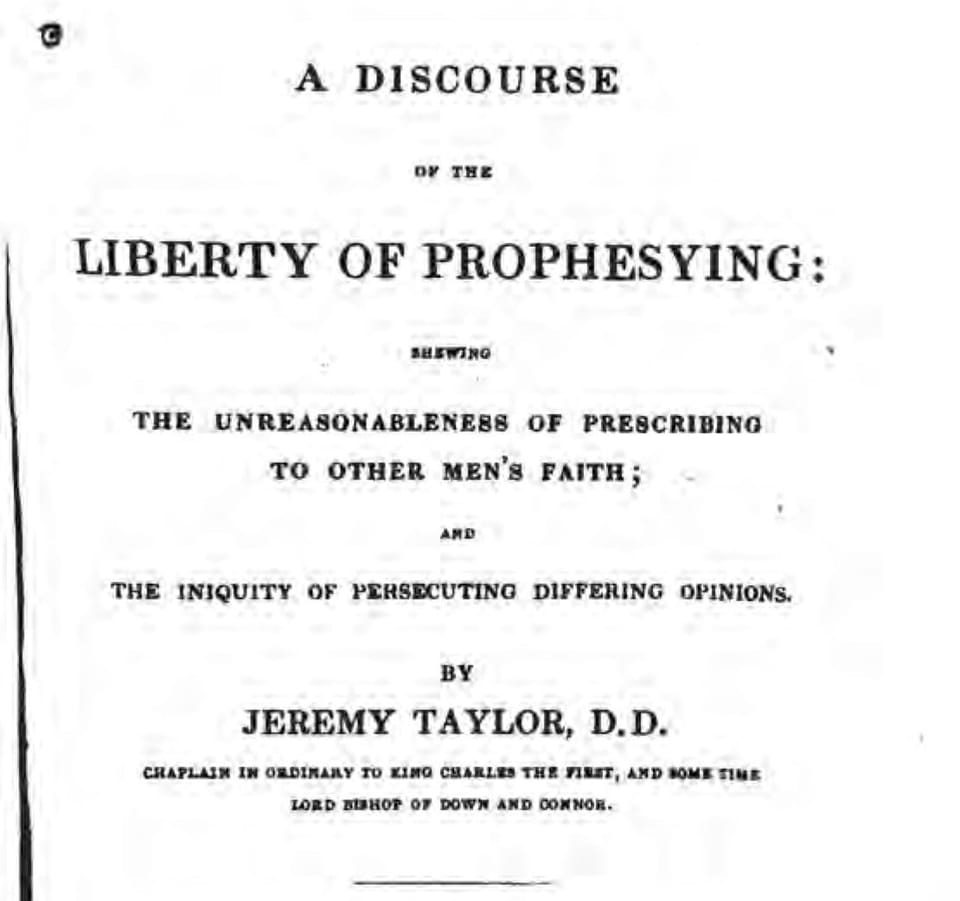
Part One Recap: After revealing that Benjamin Franklin’s Parable Against Persecution was in fact a retelling of a 13th century poem by the Persian poet Saadi of Shiraz, Part One of this series gave a brief history of the Parable in its own time, including how Franklin and others used it to argue for religious tolerance; the discovery that it was essentially identical to the story told by Jeremy Taylor at the end of his Discourse of the Liberty of Prophesying, which had been published more than a century earlier; and the charges of plagiarism that were subsequently lodged against Franklin. Part Two will explore how Saadi’s story likely came to Taylor’s attention.
As a member of the Anglican clergy, Jeremy Taylor was harassed and imprisoned by the Puritan authorities during the English Civil War because his Anglicanism too closely resembled the Catholicism they opposed. In response to that experience, he published the Discourse of the Liberty of Prophesying, the second edition of which, appearing in 16461, concluded with his version of the story that became Franklin’s Parable. (It is, literally, the last paragraph.)
I end with a story which I find in the Jews’ books: When Abraham sat at his tent door, according to his custom, waiting to entertain strangers, he espied an old man stooping and leaning on his staff, weary with age and travel, coming towards him, who was an hundred years of age; he received him kindly, washed his feet, provided supper, and caused him to sit down; but observing that the old man eat and prayed not, nor begged for a blessing on his meat, asked him, why he did not worship the God of heaven? The old man told him that he worshipped the fire only, and acknowledged no other God; at which answer Abraham grew so zealously angry, that he thrust the old man out of his tent, and exposed him to all the evils of the night and an unguarded condition. When the old man was gone, God called to Abraham, and asked him where the stranger was? he replied, I thrust him away because he did not worship thee: God answered him, I have suffered him these hundred years, although he dishonoured me, and couldst thou not endure him one night, when he gave thee no trouble? Upon this, saith the story, Abraham fetched him back again, and gave him hospitable entertainment and wise instruction: “Go thou and do likewise," and thy charity will be rewarded by the God of Abraham.
Taylor’s argument in the Discourse was this: Since no human being, and therefore no single sect of Christianity, could ever be one hundred percent certain that they possessed the absolute truth of their faith, the use of political power to enforce any given Christian doctrine would ultimately lead to the unjust persecution of other sects. The only just response to this state of affairs, he asserted, was that Christians who held political power should be willing to tolerate other sects, since they all shared the same core beliefs. Taylor used the story about Abraham to argue a fortiori that if God expected the patriarch to tolerate a Zoroastrian, then He certainly must expect Christians of different denominations to tolerate each other.
This post is for paying subscribers only
Subscribe to continue reading


