14 min read

On The Trail of a Tale - Part Four: How I Came to Play a Very Small Role in Saadi’s Travels Through the World

What persuaded me to accept ISIC’s commission, however, was thinking about the generations of Iranian Americans, like my son, who did not read Persian. They deserved, I thought, access to a version of that heritage that would “sing” in their dominant tongue the way the original “sang” in Persian.
On The Trail of a Tale - Part Four: How I Came to Play a Very Small Role in Saadi’s Travels Through the World

Dear Friends,

This is the final part of the series on the connection between Benjamin Franklin’s Parable Against Persecution and the Saadi’s “Story of Abraham and the Zoroastrian.” (Part One, Part Two, Part Three) I’ve removed the pay wall from the series because I think, given the war in Iran, it’s important to make this link between American and Iranian culture visible. Starting next month, these long form essays will go back to being for paid subscribers only. If you’d like to upgrade your subscription, you can do so here.

I don’t think it ever would have occurred to me to translate classical Persian poetry if an Iranian friend hadn’t asked me in the early 2000s if I’d be interested in working with a now-defunct organization called the International Society for Iranian Culture (ISIC). ISIC, he said, was looking for someone to write the text for a website that would help counter the axis-of-evil caricature of Iranian culture and history that had been current here in the United States since the Islamic Revolution of 1979. The focus of the website would be classical Persian literature. My job would be to make that literature and its place in Iranian and world culture accessible to an online American audience.

I was immediately interested. Since my wife is from Iran and my son is therefore Iranian-American, I had a real stake in the cultural awareness about Iran that ISIC wanted to engender; and, as a college professor and a writer, not only did I think the educational value of the project was self-evident; I also saw it as an opportunity to learn about a literature I knew next to nothing about. When I asked my friend if ISIC might see that ignorance as disqualifying, he told me not to worry. They actually wanted someone who would approach the literature from well outside the specialized and scholarly contexts in which those texts were usually read and studied.

My friend put me in touch with the man who was pre-screening those people who’d been identified as viable candidates for the project, and then he, after a long conversation of which I remember very little, told me I would hear within the next week or so from ISIC’s executive director, Mehdi Faridzadeh. When I met with Mr. Faridzadeh, however, the project he described to me was not only radically different from the one my friend had told me about; it was one I knew right away that I was not qualified to take on.

“We want you to produce,” he said, “book-length literary translations of selections from masterpieces of classical Persian literature. All told there are ten. We’re asking you to do five at a time.”

I did not hesitate. I immediately rejected his offer. While I spoke some Persian, I did not read it. How could I possibly presume to translate from it? Surely, I asked, there were bilingual poets and writers capable of doing this work. Why wasn’t he talking to them? He’d reached out to them first, he said, but, with very few exceptions, none were interested in working on classical texts, and the ones who did had either not responded to his query or had told him outright that they had other commitments. Since he wanted work to start on the project as soon as possible, he’d decided not to wait for them.

I pushed back. Given my lack of the obvious minimum qualifications, I said, I did not see how I could accept his commission or do the work with any integrity. Mr. Faridzadeh responded by pointing out to me something that I already knew, the long history of poets translating works from languages in which they were not literate by relying on informants and what are known in the field of translation as “trots” or “ponies.” These are literal or near-literal versions done by native speakers that the poets then use as a basis for the literary translations they produce. ISIC would provide me, he said, with English-language versions of the original texts that were widely recognized as valid, as well as access to scholars who could answer my questions and help me with any difficulties. Moreover, he went on, since he wanted the translations to stand on their own as contemporary American literature, as something a general readership might actually enjoy reading, he preferred the idea of working with someone like me, a native English-speaking poet, to working with someone who was bilingual but had neither a poet’s ear nor a poet’s way with words.

I’d be lying if I said that the prospect of earning myself a footnote in American literary history by producing these translations did not appeal to me. What ultimately persuaded me to accept ISIC’s commission, however, was a point Mr. Faridzadeh made about the generations of Iranian Americans who did not read Persian and for whom translations like the ones ISIC wanted to publish would be their only access to the classical literature that was part of their heritage. I thought about my son and others like him. They deserved, I thought, access to a version of that heritage that would “sing” in their dominant tongue the way the original “sang” in Persian. So, I agreed to produce a sample couple of pages from Saadi’s Gulistan, and when Mr. Faridzadeh called me a week or so later to tell me the project was mine if I wanted it, I accepted, though I was not at all prepared for the politics of the terrain I was entering.

§§§

I did not know it at the time, but I actually got my first glimpse of that terrain long before I accepted ISIC’s commission. I was telling my friend, the same one who recommended me to ISIC, about the wedding ceremony my wife and I had written for ourselves. In lieu of traditional wedding vows, we’d each chosen a poem to read. My wife read an English translation of one by Yehuda Amichai; I read my own version of a poem by the 14th century Persian poet Hafez.

“Wait a minute,” my friend interrupted me. “You don’t read Persian. So what exactly do you mean by ‘your version?’”

“I made it based on a translation I found in a book I own,” I said.

“Not one of Daniel Ladinsky’s, I hope.”

“Who’s Daniel Ladinsky?” I’d based my poem on a translation by Michael Boylan that I found in Hafez: Dance of Life.

“Ladinsky calls himself a translator, but he really isn’t.”

That brief exchange began a conversation my friend and I would return to again and again over the years about the politics and socioeconomics of translating classical Persian poetry into English. It was in those conversations that I first learned not only how important a poet Hafez was, but also how thoroughly Ladinsky has misrepresented him—aided and abetted by the fact that, like me, Ladinsky doesn’t read Persian. On the surface, in other words, our processes are structurally identical. We each begin with English-language versions of the poems we translate and arrive at very different English-language versions of our own.1

For that reason, my work was often met with the same derisive suspicion I heard in my friend’s voice when he first said Ladinsky’s name. “Just get out of the way and let us translate our own literature,” one Iranian translator told me. “Haven’t you monolingual people done enough damage?” That person and I would often run into each other at literary events, and she always made a point of introducing me to a new group of people—she was much better-known as a poet and translator than I was—by saying, “Let me introduce Richard Jeffrey Newman, who translates classical Persian literature even though he does not speak Persian.”

Sometimes, I heard in people’s criticism of my work perspectives I thought were worth accounting for:

Calling it Persian literature perpetuates the imperialist misnaming of our country. Persians are only one of the ethnic groups living in Iran to have produced a written literature, and despite what the British decided your maps should say, the land was and is called Iran. So, if you’re going to call yourself a translator, you should at least do your homework and call the work you’re presuming to translate what it is: classical Iranian literature.

That seemed an entirely valid point, but when I did as that person suggested, I very quickly learned there was another side to that argument:

English literature is literature written in English—American, British, Australian, South African, Scottish, even Indian. It doesn’t matter. That’s why it’s called English literature. The work you’ve translated was written in Persian, so why not call it what it is: classical Persian literature.

The critique I learned the most from, however, came from someone I was on a translation-related conference panel with in 2005, shortly after my Selections from Saadi’s Gulistan came out. “I’m not suggesting Richard doesn’t belong on our panel,” he wrote, talking about me in the third person in an email that I too received, “but if he’s not bilingual, if what he does is essentially what Coleman Barks does, can we really call his work translation? Can we call him a translator?” (Barks is to Rumi as Daniel Ladinsky is to Hafez.)

I cannot find the email I wrote in response, but I remember very deliberately choosing to ignore that colleague’s dismissive subtext and trying instead to articulate what I thought of as the helpful and clarifying distinction his two very different questions helped me to make. I wrote back that I did not think of myself as a translator per se, which was why the title page of my Gulistan noted very prominently that it was based on the 1888 translation made by Edward Rehatsek. I was, however, perfectly comfortable describing what I produced as translations, since I made every effort to keep them tethered semantically to the choices Rehatsek had made. In essence, in other words, I saw (and see) myself as a co-translator, and I have never claimed any authority for my work other than that.

§§§

I tried to compensate for my ignorance of Persian and Persian literature in two primary ways. First, since classical Persian poetry is written in form, I committed myself to identifying in English a formal analogue for each work ISIC asked me to translate. For example, the two books by Saadi that I was asked to work with, Gulistan and Bustan, are what we would call didactic literature, which made me think of Alexander Pope more than anyone else. However, since I thought that Pope’s heroic couplets would sound too anachronistic in 21st century American English, I chose to render my versions of Saadi in blank verse. The second way in which I tried to maintain the integrity of the work I was doing was to learn as much as possible about the reception of classical Persian literature in English. That research is what led me to the connection between Saadi’s “Tale of Abraham and the Zoroastrian” and Benjamin Franklin’s Parable Against Persecution. It also revealed to me the racist and patronizing side of Saadi’s reception into English. Here, for example, is A. Hart Edwards’ explaining why his 1911 translation of Bustan was in prose:

[T]he invariable rule of Sadi, like that of every other Persian poet we have read, is to sacrifice sense to the exigencies of rhyme and metre [sic]. In not a few cases the meaning is so confused…that even the native commentators…have been compelled to pass over…couplets through sheer inability to unravel their intricacies and the abstruse ideas of the poet.

The construction of sentences follows no rule; the order of words is just that which the individual poet chooses to adopt, and the idea of time—past, present, and future—is ignored in the use of tenses, that part of a verb being alone employed which rhymes the best.

The poems abound in metaphor, a figure of style which Eastern writers employ to a degree that is always exaggerated, and sometimes tedious…[F]or the purpose of this translation, which aims at a happy medium between literal accuracy and the freedom requisite in order to render Oriental phraseology into polite English, numerous of the more far-fetched allusions have been discarded, to the benefit of the text.

My translations are certainly not without error. Some resulted from my own ignorance; others from the difficulty I had understanding the compressed and archaic English of the trots that ISIC gave me. (On occasion, I had to consult the Oxford English Dictionary to make sense of what those translators meant.) Nonetheless, I know that my translations have some merit because, in addition to the critical responses I quoted for you above, I also received responses like these:

“I trust Richard’s translations and I use them in my classes. He’s honest about not reading Persian, and he’s up front about how he tries to account for that. You can’t say that about Coleman Barks.

“I know Gulistan-e Saadi by heart. My father taught me when I was very young, and I’ve been studying it ever since. Your translations are so close to the original, even though you’re not Iranian, and you’re not fluent in Persian. How did you do that?”

§§§

I do not want to make ISIC’s commission seem more monumental than it was, but accepting it temporarily and very tangentially involved me in the Islamic Republic’s attempts to normalize itself within the United States. I did not understand this fully, however, until after the project was already in process. I’d known from the start that Mr. Faridzadeh had served as Iran’s cultural ambassador to the United Nations. What I did not know was that ISIC drew at least part of its funding from former Iranian President Mohammad Khatami’s Dialogue Among Civilizations initiative. Positioned as a response to Samuel P. Huntington’s notion of “the clash of civilizations,” this initiative ostensibly provided a model for how nations could learn to coexist even across what might otherwise seem to be insurmountable differences. Separate and apart from any individual’s motives and/or the cultural value of ISIC’s work on its own terms—despite, in other words, my personal reasons for accepting ISIC’s commission—both the organization as a whole and my project in particular were also part of a larger agenda, a point that was driven home for me when Mr. Faridzadeh told me I’d been invited to have lunch at Iran’s mission to the United Nations.

I did not know then that the man I had lunch with, Hossein Fereydoun, whom Mr. Faridzadeh had led me to believe was serving in the role of cultural ambassador, was actually one of Iran’s senior United Nations diplomats. Almost by definition, then, this meant that what he wanted to talk about—a project to integrate the work I was doing for ISIC into secondary and post-secondary curricula in the United States—had already been given a weight and authority of which I was completely unaware. I was focused instead on how his idea could build on the potential I’d already seen in the way audiences responded to the readings and presentations I gave about my translations. People were often surprised to learn that Islam was not the religion of undifferentiated violence and hatred they’d been led to believe that it was; and the questions they asked often did point in the direction of the kind of dialogue that Khatami’s initiative was intended to promote.

It was not hard, in other words, to feel like the value of promoting that dialogue outweighed all other considerations, but, in the end, the question was moot. Ambassador Fereydoun was called back to Iran after Mahmoud Ahmadinejad was elected Iran’s president in 2006, and Ahmadinejad’s hostility towards the United States not only dried up whatever official support ISIC was receiving from Iran itself, but it also made ISIC’s connection to the Iranian government anathema to the funders Mr. Faridzadeh had relied on in the United States. Or at least that’s the way he explained it to me when he told me he could no longer support the work I was doing. I did try briefly to continue on my own, publishing a translation of Farid al-Din Attar’s “Tale of Marhuma” from his Elahi Nameh (Book of God), in the Winter 2017 issue of Modern Language Studies, but without the institutional backing that ISIC had provided, my lack of qualifications—academic, linguistic, or otherwise—became even more prominent. My career as a co-translator of classical Persian literature was essentially over.2

Then, in March of last year, I received a message through the contact form on my website from Hasan Dehghan, the Deputy Director of the General Department of Culture in the Fars Province of Iran, which is where Shiraz, Saadi’s city, is located. In honor of Saadi Day, which falls on April 21, Mr. Dehghan explained, his department planned to print a thousand copies of an English translation of Saadi’s Gulistan and give them to tour guides to distribute free of charge to English-speaking tourists. “Our hope,” he wrote, “is that after reading the book, these travelers will pass it on to others in their home countries, creating a cycle that ensures the book reaches as many readers as possible.” He wanted to know if I would give him permission to use my Selections from Saadi’s Gulistan for this purpose.

I was immediately struck by the difference between the project that Mr. Dehghan described and the project into which ISIC had at least partially recruited me. While both focused on cultural exchange, ISIC’s goal—and, by extension, that of the Islamic Republic—had been in no small measure both institutional and structural. They wanted to have an impact not just on the bookshelves of American readers, but in both the classrooms where American students learn about the world and the disciplines where decisions are made about which literatures belong in those classrooms. Mr. Dehghan’s project, on the other hand, seemed to be about (re)introducing Saadi’s work to the English-speaking world in a way that could not be circumscribed by official, institutional channels, neither those of his government nor anybody else’s.

The difference is not inconsequential. It seems obvious to me in hindsight, but I was in many ways a singularly unfit choice to be the face of the project ISIC and Ambassador Fereydoun had in mind. I had neither the expertise nor the institutional/disciplinary standing to be taken seriously at the level where it would truly have made a difference. In the context of Mr. Dehghan’s project, on the other hand, my identity was irrelevant. What mattered was the quality of the translation itself, nothing more and nothing less.

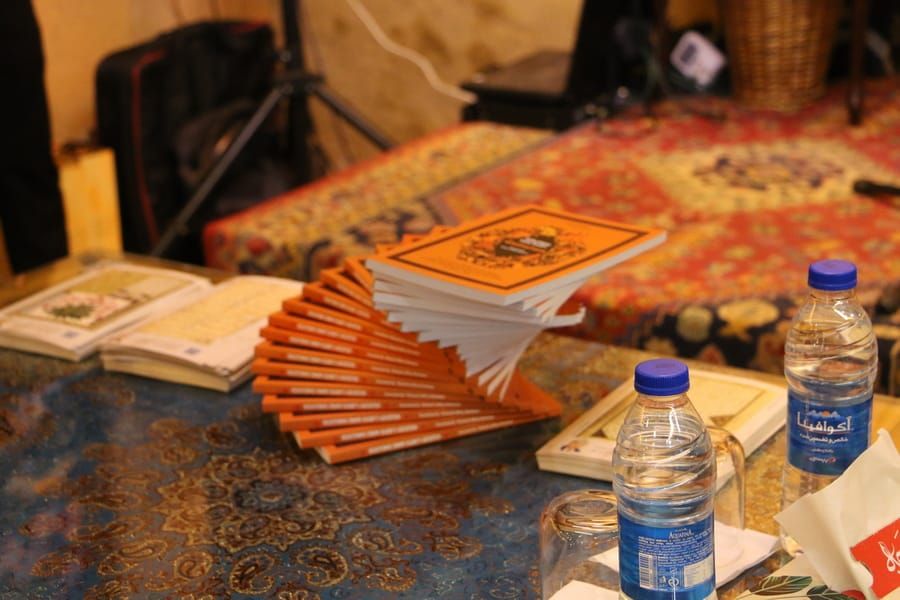
I responded to Mr. Dehghan with an enthusiastic yes and, after a brief exchange about logistics and some corrections I asked him to make in the original manuscript, the second edition of my Selections from Saadi’s Gulistan was launched in Shiraz on April 21, 2025.

The thousand copies were distributed among twenty-two tour guides, Mr. Dehghan wrote when he sent me those pictures, but the rest, the paths my Selections from Saadi’s Gulistan will travel, the companions it will have along the way—Mr. Dehghan did not say this, but Saadi himself might have put it this way—is up to fate.

That uncertainty and the potential for subversion that lies within it, seem to me now more important than ever, especially given the polarized nature of the world today, including but not limited to the wars in Iran, Gaza, Lebanon, and Ukraine. It’s not that I think Saadi’s work has the capacity in and of itself to end war or in any direct way to bring about a more just world; but just as no one could have predicted the path by which his story about Abraham and the Zoroastrian would become Benjamin Franklin’s Parable Against Persecution, a text that played a small but nonetheless very real role in the history of religious tolerance here in the United States, it’s impossible to know—but it does give me hope to think about—what impact that same humanistic impulse might have on those who get to know Saadi through my version of his work.


  1. There is, actually, a lot more to be said about both Daniel Ladinsky and Coleman Barks, whose versions of Rumi are problematic for similar reasons. If you’re interested to learn more, you might try “Rewriting Hafez: Re-Theorizing Untranslatability in Persian Poetry,” by Aria Fani, which places its critique of Ladinsky in a broader, more scholarly context, “The Erasure of Islam from the Poetry of Rumi” by Rozina Ali; “Coleman Barks and Rumi’s Donkey,” by Majid Nafici; or, if you would like a full-on scholarly take, try “Americanizing Rumi and Hafez: The Return of Emerson’s Verse Translation,” chapter 5 in Roger Sedarat’s Emerson in Iran. ↩︎
  2. PDFs of the three books I did publish, which have long been out of print, are available on my website; and I have recently begun posting poems from Saadi’s Bustan because I think the US-Israeli war against Iran makes it important for Iranian culture to be visible here in ways it might otherwise not be. ↩︎
Subscribe to It All Connects...

It All Connects is for anyone who grapples with complexity—of identity, art-making, culture, or conscience—to make a difference in their own life and, potentially, in the life of their community.