On The Trail of A Tale - Part One: Benjamin Franklin's Persian Parable
Had Franklin gotten his wish...and the Parable had remained unpublished, neither its origin in the work of the 13th-century Persian poet Saadi of Shiraz nor the story I am telling you would have become known, at least not in the way we know them now.
When the now-defunct International Society for Iranian Culture (ISIC) commissioned me in the early 2000s to produce literary translations of selections from five masterpieces of classical Persian literature, we were knee-deep in President George W. Bush’s 2002 state-of-the-union rhetoric about the Axis of Evil, which included North Korea, Iraq, and Iran. I will tell a more complete version of the story of that commission later in this series. For now, what matters is that ISIC’s goal was for those translations to open a window onto Iran’s history and culture that more Americans at the time had never had a chance to look through. The importance of this goal was then underscored some years later when John McCain sang the parody “Bomb Iran” during his 2008 presidential campaign. That context gave the work I was doing a kind of urgency I’d never before experienced. Then, just a year or so later, the 2009 Green Movement protests in Iran added a layer to that urgency, since inviting people to look through the window my translations provided became not only an attempt to break down stereotypes, but also, in a very small way, an act of support for that movement. That was also the year that ISIC’s commission effectively came to an end and my work as a translator of classical Persian literature receded far into the background of my writing career. The recent civil unrest in Iran, however, coupled with the horrors that have been revealed afterwards, brought to mind the story I want to tell in this series about a historical and cultural connection not just between Iran and the United States, but between Islam and the Christian west that few people know about. Given that Iran, its people, and its culture are once again hotly contested territories, this feels like a good moment to tell this tale.
Richard
Imagine yourself in 1760s London sitting around a table with a group of friends that includes William Strahan, the king’s printer, and Benjamin Franklin, who is visiting from America. When the conversation turns to the subject of religious persecution, Franklin argues in favor of tolerance and asks someone to bring him a Bible so he can make his point. Turning to the book of Genesis, he begins, he announces, to read aloud from chapter twenty-seven:
And it came to pass after these things, that Abraham sat in the door of his tent, about the going down of the sun. And behold a man, bowed with age, came from the way of the wilderness, leaning on a staff. And Abraham arose and met him, and said unto him, “Turn in, I pray thee, and wash thy feet, and tarry all night, and thou shalt arise early on the morrow, and go on thy Way.”
And the man said, “Nay, for I will abide under this tree.”
But Abraham pressed him greatly; so he turned, and they went into the tent; and Abraham baked unleavend bread, and they did eat. And when Abraham saw that the man blessed not God, he said unto him, “Wherefore dost thou not worship the most high God, creator of heaven and earth?”
And the man answered and said, “I do not worship the God thou speakest of; neither do I call upon his name; for I have made to myself a God, which abideth always in mine house, and provideth me with all things.”
And Abraham’s zeal was kindled against the man; and he arose, and fell upon him, and drove him forth with blows into the wilderness. And at midnight, God called unto Abraham, saying, “Abraham, where is the stranger?”
And Abraham answered and said, “Lord, he would not worship thee, neither would he call upon thy name; therefore have I driven him out from before my face into the wilderness.”
And God said, “Have I born with him these hundred ninety and eight years, and nourished him, and clothed him, notwithstanding his rebellion against me, and couldst not thou, that art thyself a sinner, bear with him one night?”
And Abraham said, “Let not the anger of my Lord wax hot against his servant. Lo, I have sinned; forgive me, I pray Thee.” And Abraham arose and went forth into the Wilderness, and sought diligently for the man, and found him, and returned with him to his tent; and when he had entreated him kindly, he sent him away on the morrow with gifts.
And God spake again unto Abraham, saying, “For this thy sin shall thy seed be afflicted four hundred years in a strange land. But for thy repentance will I deliver them; and they shall come forth with power, and with gladness of heart, and with much substance.”
We know that this event took place because someone with the initials W. S.—most probably Strahan—published a letter about it, along with a copy of the story that he’d obtained from Franklin, in a periodical dated April 16, 1764. I have not been able to locate that periodical, but I know it existed because Duncan Forbes, who found it reproduced in the Notes and Queries of July 29, 1854, cited it in an appendix to his 1862 A Grammar of the Persian Language. If you know your Bible, or even if you’ve gone, as Strahan did, to check what Franklin “read” against the Biblical text, then you are almost certainly wondering two things. First, since that narrative appears nowhere in the book of Genesis, where did it come from; and, second, what does the text Franklin must have recited from memory have to do with the study of Persian grammar?
The answer to the first question is easy. Franklin wrote it, though he did not originally intend it for publication. Instead, as Joseph Priestley attested in a footnote in his Observations on the Increase of Infidelity, Franklin committed the text to memory and used it both to argue for tolerance, like he did in Strahan’s company, and, as Priestley reported, to fool people who fancied themselves especially learned into believing that something was part of the Bible when it wasn’t. There’s also reason to believe he kept a copy tucked into the pages of his Bible in order to make his ruse seem more real. Either way, as Franklin wrote to Strahan after he became aware that the text had been published, “I was always unwilling to give a Copy [to anyone] for fear it should be printed, and by that means I should be depriv’d of the Pleasure I often had in amusing People with it.”
The full bibliographical history of what became known as the Parable Against Persecution is quite complicated, though you can find a summary that’s not too difficult to follow here. Had Franklin gotten his wish, however, and the Parable remained unpublished, neither its origin in the work of the 13th-century Persian poet Saadi of Shiraz nor the story I am telling you would have become known, at least not in the way we know them now. Before I continue, though, here is my version of Saadi’s original, which is based on the translation that G. M. Wickens published in 1974:
I’ve heard that once a week went by when no one wandering the world stopped at the tents of Allah’s Friend, whose practice was to eat his meals only at the proper time unless a poor or homeless person came to his door. So he stood outside his tent and looked around. At the edge of the valley he saw a man whose hair age had powdered white, sitting bent and lonely in the desert like a willow. Abraham called out his warmest welcome, “Light of my eyes! Come! Share with us the salt and bread of my table!” Recognizing Abraham at once, the old man sprang to his feet, eager to obey the summons. Abraham’s attendants gave the lowly guest a seat of honor, called for the table to be set, and took their own seats; but when they said together “In God’s Name…” no words escaped the old man’s mouth. Abraham spoke, “I do not see in you the passion and sincerity of faith that men of your age usually express. Aren’t we obliged each time we eat to thank the One who filled our plates?” The old man answered, “I will not speak of God except as I have learned to do from my teachers. I am Zoroastrian.”
Once God’s favored messenger found out the destitute old man was just a gabr[^A derogatory term for Zoroastrian], he chased him like a stray dog from the tent. (The pure of heart cannot abide such filth!) But then, from Heaven, the voice of God’s reproof came down, “Dear Friend! I have fed this man, and given him his life these hundred years, but you, in a single moment, were filled with hate. Why refuse him hospitality just because he bows before a fire?” Don’t knot the rope of generosity just because you find, in this one, fraud and deceit; in that one, trickery and cunning.
A religious scholar bargains poorly when he sells wisdom and exegesis for mere bread. Neither reason nor God’s holy law approves the exchange of faith for worldly things. But you, if you are wise, will gladly pay. When someone sells so cheaply, you have to buy.
The differences between Franklin’s Parable and Saadi’s original—which I will write about more specifically in a later part of this series—result from the five-hundred-year journey the poem took from Iran through Germany and England, possibly by way of France, and across the Atlantic Ocean to the thirteen colonies, crossing as well the borders of at least four languages and four religious traditions (assuming you count Franklin’s Deism as more than a personal spiritual orientation).
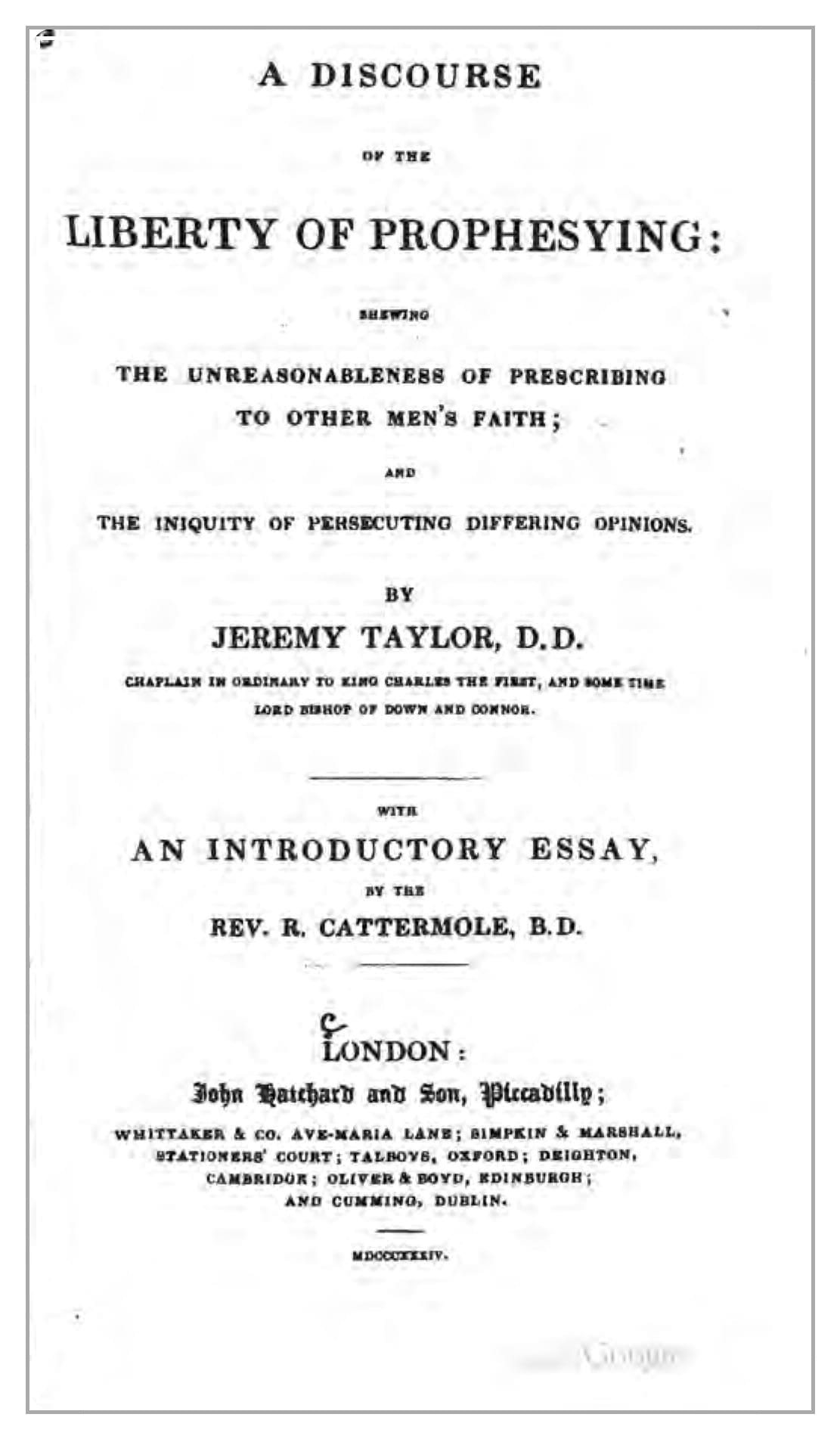
The first hint that Franklin’s Parable had been on this journey came in 1781, when someone going by the initials H.S. revealed in the Gentleman’s Magazine that it was essentially identical to the story with which Jeremy Taylor, then a royalist Anglican cleric, concluded the second edition of his A Discourse of the Liberty of Prophesying in 1646.
This is Taylor’s version of the story:
I end with a story which I find in the Jews’ books: When Abraham sat at his tent door, according to his custom, waiting to entertain strangers, he espied an old man stooping and leaning on his staff, weary with age and travel, coming towards him, who was an hundred years of age; he received him kindly, washed his feet, provided supper, and caused him to sit down; but observing that the old man eat and prayed not, nor begged for a blessing on his meat, asked him, why he did not worship the God of heaven? The old man told him that he worshipped the fire only, and acknowledged no other God; at which answer Abraham grew so zealously angry, that he thrust the old man out of his tent, and exposed him to all the evils of the night and an unguarded condition. When the old man was gone, God called to Abraham, and asked him where the stranger was? he replied, I thrust him away because he did not worship thee: God answered him, I have suffered him these hundred years, although he dishonoured me, and couldst thou not endure him one night, when he gave thee no trouble? Upon this, saith the story, Abraham fetched him back again, and gave him hospitable entertainment and wise instruction: “Go thou and do likewise," and thy charity will be rewarded by the God of Abraham.
While it was impossible to prove definitively that Taylor was Franklin’s source, the similarity between the two versions made it more likely than not that he was. As a result, those who were predisposed to do so began charging Franklin with plagiarism. Since he neither published the Parable himself nor claimed original authorship—except, as he put it in a letter, for “the concluding threatening and promise”—Franklin himself didn’t take the charges seriously. Nonetheless, the charges themselves were debated and discussed for a good long time afterwards. Scandal might be too strong a word to describe it, but the question of whether or not Franklin was a plagiarist became a minor controversy that lasted at least fifty years beyond the Parable’s publication. The Guernsey and Jersey Magazine, for example, published in 1836 a narrative, almost certainly fictional, in which a man from New England lost a horse, a saddle, and a bridle in a wager with a man from Virginia that the Virginian won by producing Taylor’s version and proving Franklin was not the original author.
One reason the plagiarism charges held such lasting interest, in addition to the fact that they’d been lodged against someone as famous and important as Benjamin Franklin, was the Parable’s huge popularity. It was anthologized well into the 1880s as an example of the kind of tolerance people should aspire to. There is even some evidence that a biblical Hebrew version exists among the unpublished writings of the Jewish philosopher, theologian, and historian Nachman Krochmal. More to the point of our story here, though, even as early as the 1780s, the Parable was being used to argue for religious tolerance independently of the fact that Franklin was its author. It was printed, for example, in an anonymous pamphlet, likely penned by Joseph Priestley, that responded to the backlash against the Catholic Relief Act of 1778, which eased some of the restrictions that at the time excluded Catholics from public life. That pamphlet, A Free Address to Those Who Have Petitioned for the Repeal of the late Act of Parliament, in Favour of the Roman Catholics, used the Parable in much the same way that both Jeremy Taylor and his likely source, the 17th century Hebraist George Gentius, used their versions of the story. Next month, we’ll walk that part of this trail back to the tale's origin in Part Two of this series.
Subscribe to It All Connects...
It All Connects is for anyone who grapples with complexity—of identity, art-making, culture, or conscience—to make a difference in their own life and, potentially, in the life of their community.
You might also like
On My Desk Now: Translating Korean Poetry
I’ve had an interest in translating poetry for as long as I can remember. As an undergraduate, I was
The Power We Pretend Not To See - 4
None of the responses I found asked why the chasteness Donne’s speaker craves should require an act of sexual violence in the first place, much less one that is generally understood in the real world to be something men perpetrate almost exclusively against women.
On The Trail of a Tale - Part Two: The Sources of Franklin’s Parable in 17th Century Christian Arguments for Religious Tolerance
For Saadi, in other words, the Zoroastrian’s sincere commitment to his faith was worthy of respect on its own terms and was therefore more valuable as a guide for human behavior than the orthodoxy he would have been merely performing had he given thanks to God as Abraham had expected him to.
Four by Four #52
Four Things To Read, Four Things To See, Four Things To Listen To, and Four Things About Me






Member discussion