On The Trail of a Tale - Part Two: The Sources of Franklin’s Parable in 17th Century Christian Arguments for Religious Tolerance
For Saadi, in other words, the Zoroastrian’s sincere commitment to his faith was worthy of respect on its own terms and was therefore more valuable as a guide for human behavior than the orthodoxy he would have been merely performing had he given thanks to God as Abraham had expected him to.
Part One Recap: After revealing that Benjamin Franklin’s Parable Against Persecution was in fact a retelling of a 13th century poem by the Persian poet Saadi of Shiraz, Part One of this series gave a brief history of the Parable in its own time, including how Franklin and others used it to argue for religious tolerance; the discovery that it was essentially identical to the story told by Jeremy Taylor at the end of his Discourse of the Liberty of Prophesying, which had been published more than a century earlier; and the charges of plagiarism that were subsequently lodged against Franklin. Part Two will explore how Saadi’s story likely came to Taylor’s attention.
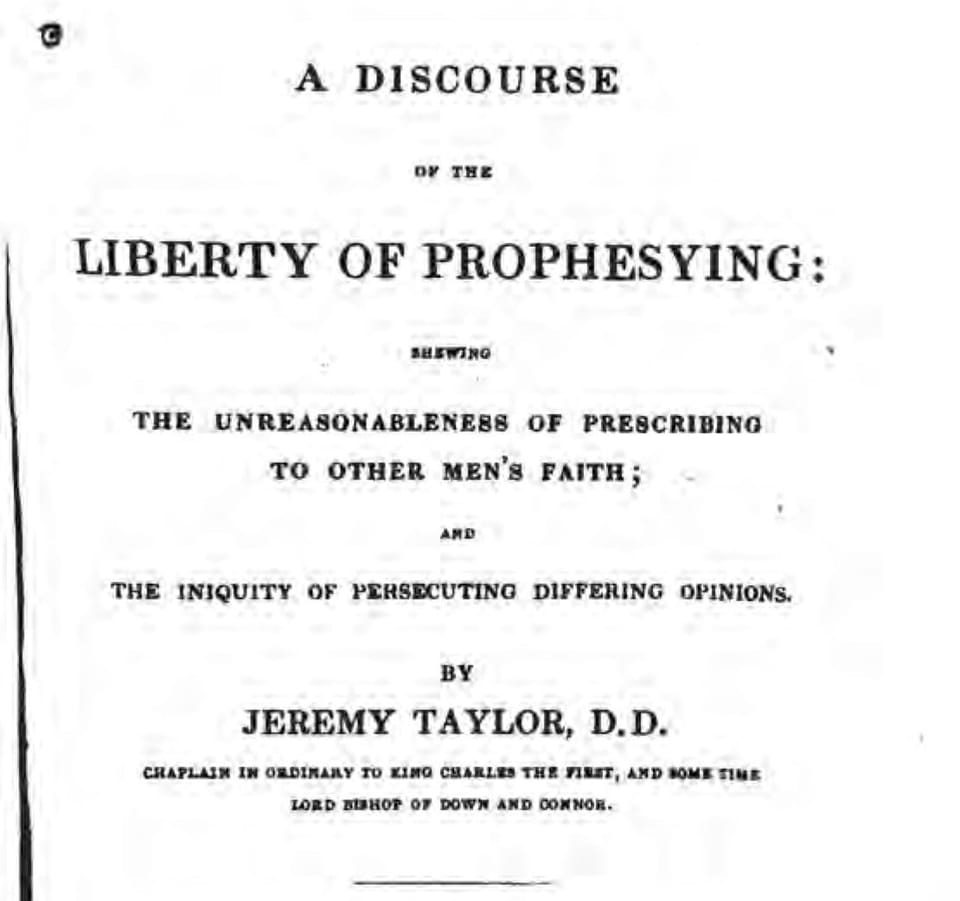
As a member of the Anglican clergy, Jeremy Taylor was harassed and imprisoned by the Puritan authorities during the English Civil War because his Anglicanism too closely resembled the Catholicism they opposed. In response to that experience, he published the Discourse of the Liberty of Prophesying, the second edition of which, appearing in 16461, concluded with his version of the story that became Franklin’s Parable. (It is, literally, the last paragraph.)
I end with a story which I find in the Jews’ books: When Abraham sat at his tent door, according to his custom, waiting to entertain strangers, he espied an old man stooping and leaning on his staff, weary with age and travel, coming towards him, who was an hundred years of age; he received him kindly, washed his feet, provided supper, and caused him to sit down; but observing that the old man eat and prayed not, nor begged for a blessing on his meat, asked him, why he did not worship the God of heaven? The old man told him that he worshipped the fire only, and acknowledged no other God; at which answer Abraham grew so zealously angry, that he thrust the old man out of his tent, and exposed him to all the evils of the night and an unguarded condition. When the old man was gone, God called to Abraham, and asked him where the stranger was? he replied, I thrust him away because he did not worship thee: God answered him, I have suffered him these hundred years, although he dishonoured me, and couldst thou not endure him one night, when he gave thee no trouble? Upon this, saith the story, Abraham fetched him back again, and gave him hospitable entertainment and wise instruction: “Go thou and do likewise," and thy charity will be rewarded by the God of Abraham.
Taylor’s argument in the Discourse was this: Since no human being, and therefore no single sect of Christianity, could ever be one hundred percent certain that they possessed the absolute truth of their faith, the use of political power to enforce any given Christian doctrine would ultimately lead to the unjust persecution of other sects. The only just response to this state of affairs, he asserted, was that Christians who held political power should be willing to tolerate other sects, since they all shared the same core beliefs. Taylor used the story about Abraham to argue a fortiori that if God expected the patriarch to tolerate a Zoroastrian, then He certainly must expect Christians of different denominations to tolerate each other.
§§§
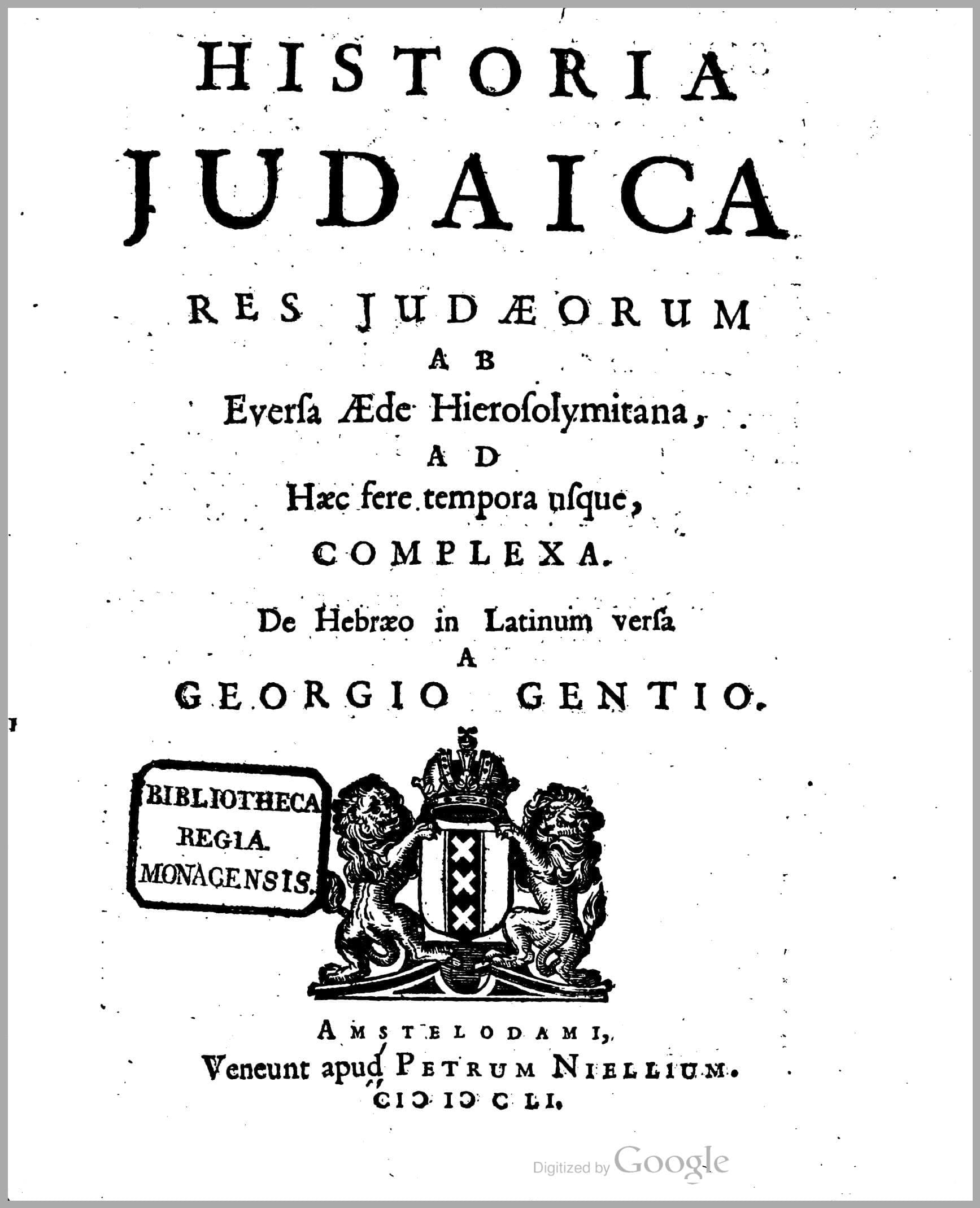
I don’t know how much attention was paid to Taylor’s Discourse outside of Anglican circles before it was discovered to be Franklin’s likely source. After that discovery, however, Taylor’s vague reference to “the Jews’ books” as his source caused some people to wonder if perhaps he’d invented the story himself and then attributed it to a third party to give it greater authority. Even as late as the 1820s, six decades or so after Franklin’s Parable was published, the Anglican cleric Reginald Heber, later Bishop of Calcutta, devoted a couple of pages to this question in his biography of Taylor. Noting first that “the works of the most celebrated Rabbins [sic] had been searched for the passage in vain,” Heber credited his “learned friend” William Oxlee, an Anglican Hebraist, with discovering a possible candidate for the Jewish book Taylor was talking about: the epistolary dedication to Historica Judaica, George Gentius’ 17th century Latin translation of Shevet Yehudah, a historiography of Jewish suffering written by Solomon ibn Verga around 1520.
A German Hebraist also schooled in Persian and Arabic, Gentius was unlike the majority of his peers in that he took Judaism and Islam seriously as moral and philosophical systems. He was not a relativist by any means—Christianity remained for him the one true religion—but he did believe that no single religious tradition had a monopoly on ethical insight, and it was this belief that both motivated his translations of Jewish and Muslim texts and informed the uses to which he put them. In explaining why he translated Shevet Yehudah, for example, Gentius wrote that he was moved by the book’s authoritative presence in Jewish culture and by the fact that it had already been translated into a number of other languages, among them German and Portuguese. He then went on to position his own translation as “a service to the [Latin-reading] public” in that it “[rescued ibn Verga] from Jewish servitude and errors and transfer[ed] him into freedom.”2
The “freedom” into which Gentius intended his translation to liberate the author of Shevet Yehudah, however, was not one to which he thought Jews ought to aspire, at least not as Jews. Rather, Gentius wanted his fellow Christians to learn from the history of their persecution of the Jews a lesson that would make them better Christians. If Solomon ibn Verga intended Shevet Yehudah as a reminder for the Jews of how perpetually vulnerable they were to the political exigencies of Christian rule—and Shevet Yehudah was among the first texts to focus on the persecution of the Jews in this way—Gentius positioned his translation as a cautionary tale for Christians. To continue to persecute the Jews as they had been doing, he argued, would be to betray the values by which the true Christian is expected to emulate Christ, “[loving] even if he is not loved, [tolerating] even if he is not tolerated, and [doing] good even to those who never do good in return…” This is ChatGPT’s translation of Gentius’ Latin version of the story (see footnote 2):
[T]he patriarch Abraham, celebrated for the glory of hospitality, scarcely believed his household fortunate unless he had welcomed a foreign guest as a kind of safeguard into his home, whom he then honored with every kind of service. Once, when he had no guest at home, he went out into the open fields seeking one, and by chance saw an old man, weighed down by age and exhausted from travel, lying beneath a tree. Abraham kindly received him, led him home, and honored him with every courtesy.
When Abraham and his household began their meal with prayers, the old man stretched out his hand to the food without any religious or pious invocation. Seeing this, Abraham addressed him thus: “Old man, it scarcely befits your gray hairs to take food without first venerating the divine.” The old man replied: “I am a worshiper of fire, ignorant of such customs; our ancestors taught us no such piety.” At these words Abraham recoiled, judged that he had dealings with a profane worshiper of fire and one alien to the worship of his God, and immediately drove him away from the meal and expelled him from his house as a pest to his fellowship and an enemy of religion.
But behold, God at once admonished Abraham: “What are you doing, Abraham? Was it right for you to act thus? I have granted that old man life and sustenance for more than a hundred years, although he is ungrateful toward me—and you cannot grant him a single meal, nor endure him for even a moment?” Warned by this divine voice, Abraham called the old man back from the road, brought him home again, and treated him with such acts of kindness, piety, and reason that he led him by his example to the worship of the true God.
While there is no definitive proof that Historica Judaica was Taylor’s source, the fact that Gentius’ nearly identical narrative was found in an unmistakably Jewish book does lend credence to the idea that Taylor first read the story in Gentius’ translation. Nonetheless, the two versions differ in at least one significant way. In Gentius’ telling, Abraham’s subsequent kindness leads the Zoroastrian to convert to Christianity, a move that the logic of his purpose for translating Shevet Yehudah all but required. Otherwise, his version of the story might have been read to imply that tolerating the Jews also meant giving up on the Christian obligation to “gather them as lost sheep of Christ.” For Taylor, on the other hand, since his argument was that Christians of different sects should not try to convert each other, ending the story the way Gentius did would have been self-defeating.
Neither those differences, however, nor the ways in which Franklin’s Parable differs from both its predecessors—most notably in his addition of God’s punishment and reward of Abraham’s descendants—alters what these three western versions of the tale have in common. They locate the story’s moral in the way Abraham changed his behavior after hearing from God. In Saadi’s original, on the other hand, the narrative ends with God’s reproof and the speaker of the poem pivots to address the reader:
Once God’s favored messenger found out the destitute old man was just a gabr3, he chased him like a stray dog from the tent. (The pure of heart cannot abide such filth!) But then, from Heaven, the voice of God’s reproof came down, “Dear Friend! I have fed this man, and given him his life these hundred years, but you, in a single moment, were filled with hate. Why refuse him hospitality just because he bows before a fire?” Don’t knot the rope of generosity just because you find, in this one, fraud and deceit; in that one, trickery and cunning.
A religious scholar bargains poorly when he sells wisdom and exegesis for mere bread. Neither reason nor God’s holy law approves the exchange of faith for worldly things. But you, if you are wise, will gladly pay. When someone sells so cheaply, you have to buy.
Those last six lines may seem like they introduce a non-sequitur, but that’s only because they don’t satisfy our desire for narrative resolution. Instead, they name as the lesson the story is intended to teach the Zoroastrian’s refusal to “exchange [his] faith” for the bread that Abraham offered him. Saadi was no more a relativist than Gentius, but within the Sufi ethos that Saadi shared, God is understood to care more about how an individual stands in relation to truth than whether that person worships “correctly.” For Saadi, in other words, the Zoroastrian’s sincere commitment to his faith was worthy of respect on its own terms and was therefore more valuable as a guide for human behavior than the orthodoxy he would have been merely performing had he given thanks to God as Abraham had expected him to. The fact that Abraham failed to learn this lesson directly from the Zoroastrian’s example is the point of the final couplet. Saadi tells his readers that when wisdom is as easily obtained as it was through that example—“when someone sells [it] so cheaply”—we should feel compelled “to buy it.”
Gentius’ Christian lens may have required him to translate out of the story the way Saadi’s version allows the Zoroastrian to remain and retain his dignity as a Zoroastrian, but he was nonetheless careful to attribute the story’s origin accurately to “Ex Sadī poeta Persa,” the Persian poet Saadi. How Saadi’s work came to play the role it did in the development of the idea of tolerance in Christian Europe is where we will pick up this story’s trail next month in Part Three.
For those who may choose to investigate this a little further: for reasons that are not entirely clear to me, the second edition of the Discourse is conventionally dated 1646 even though that precedes the conventional dating of the first edition in 1647. I have given the 1646 date here because Taylor’s version of Saadi’s tale did not appear until the second edition was published. ↩︎
Because I could not find an English translation of Historica Judaica, I am relying here on a translation that ChatGPT made from a scan of Gentius’ original Latin. ↩︎
It All Connects is for anyone who grapples with complexity—of identity, art-making, culture, or conscience—to make a difference in their own life and, potentially, in the life of their community.
You might also like
On The Trail of a Tail - Part Three: Crossing The Border from Iran to Europe
[T]ranslation as the performance of centrality—in this case of a Christian centrality—that emerges from and serves to perpetuate real political power and that is therefore both demonstrably false and inherently harmful.
From Saadi’s Bustan
A Weekly Poem from 13th Century Iran
Of Note: March 29, 2026
Dear Friends,
Here is the latest round of links to pieces dealing with the US-Israel war against Iran and related
Four by Four #53
Four Things To Read, Four Things To See, Four Things To Listen To, and Four Things About Me
On My Desk Now: Translating Korean Poetry
I’ve had an interest in translating poetry for as long as I can remember. As an undergraduate, I was






Member discussion