
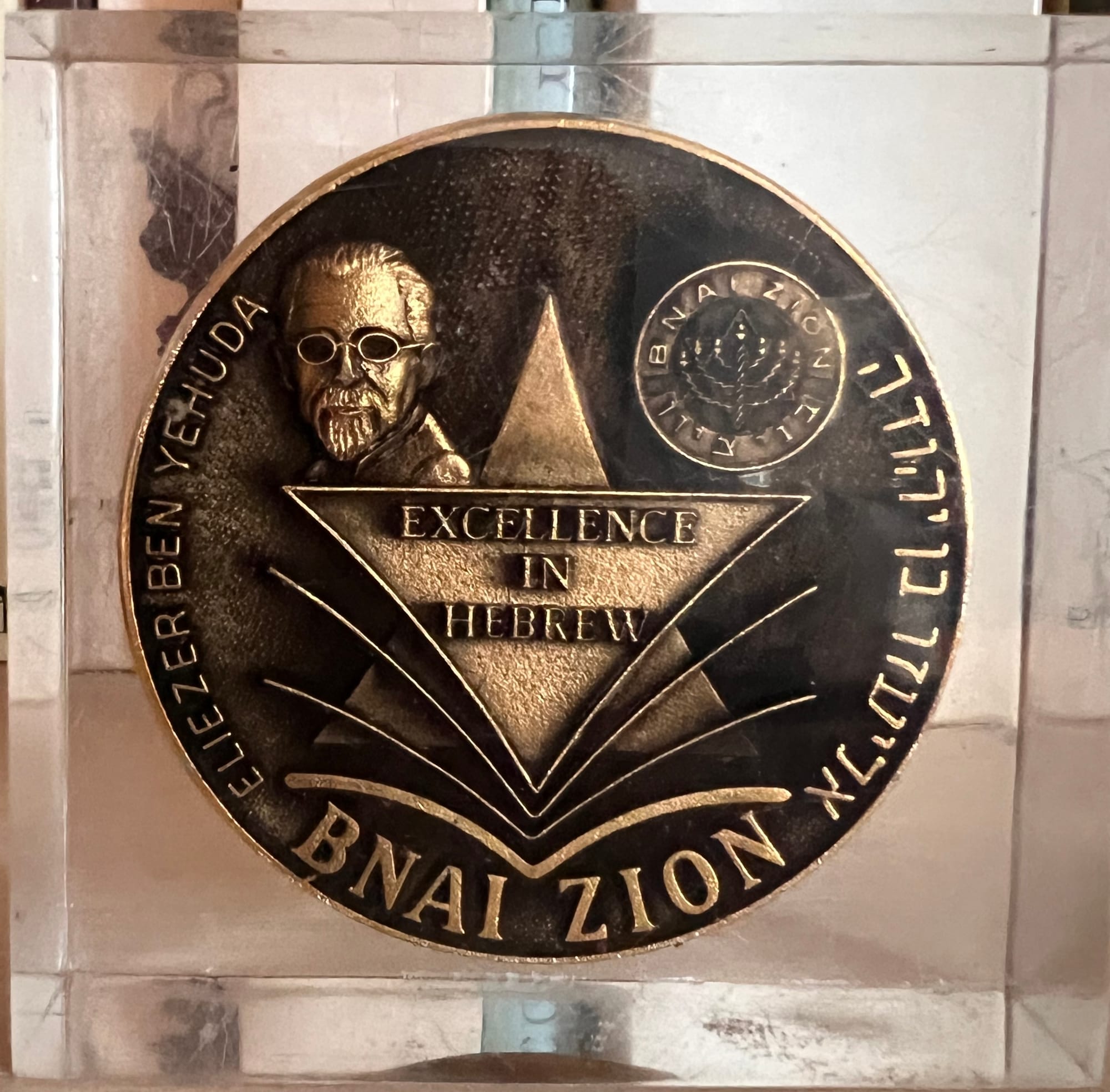
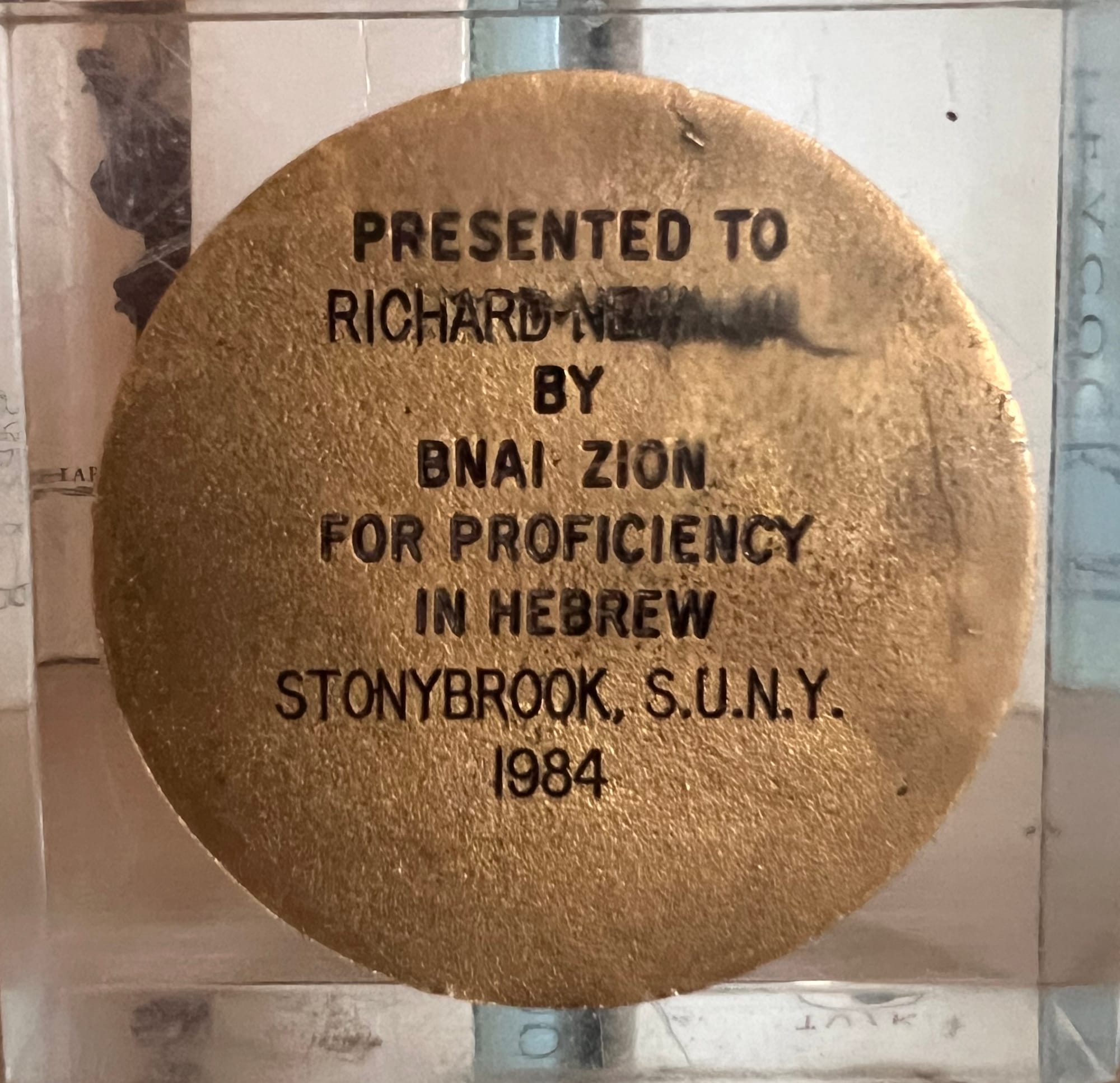
I’ve had an interest in translating poetry for as long as I can remember. As an undergraduate, I was awarded the B’nai Zion medal for excellence in Hebrew, largely on the basis of an independent study I did with Professor Robert Hoberman for which I produced translations of biblical, medieval, and contemporary Hebrew poetry. If I am ever able to locate those translations, I will publish them in a future issue of On My Desk Now.
If I had to trace my interest in translation to a single point of origin, though, it would be to the year in junior high school when I-don’t-remember-which-rebbe encouraged our class to buy the ArtScroll edition of Shir Hashirim: The Song of Songs, so that we could better understand “the most misunderstood book in the entire Tanach.” Because the ArtScroll translation was allegorical, he explained, it revealed the text’s true significance in a way that translations based on the text’s plain meaning did not. I don’t think I understood at the time what the word allegorical meant, but I was in for a shock when I opened the book. I understood Shir HaShirim to be a book of sometimes quite erotic love poems, the beginning of which is usually rendered as something like “May he kiss me with the kisses of his mouth.” The same verse in the ArtScroll version, however, is translated like this: “Communicate Your innermost wisdom to me again in loving closeness…” Many years later, I would discover a podcast episode in which the host offers a really interesting, philosophical, and very-much-worth-wrestling-with justification for the allegorical translation. At the time, though, my only response to what ArtScroll had done was anger, since the only purpose I could discern for their allegorical approach was to obscure the eroticism of the original. Ever since then, I have been fascinated by what’s at stake culturally and otherwise in why and how a text gets translated from one language into another.
That interest notwithstanding, the possibility of translating Korean literature did not even enter my mind when I arrived in the country in the summer of 1988. One of the first friends I made there, however, a woman who worked the front desk at the school where I taught—her name was Yu Eun Hee—had majored in Korean literature in college and when she told me that she hoped one day to publish English translations of Korean poetry, we decided it would be a fun project to work on together. She chose the poems, rendered them in English as best she could and then we worked together on shaping that initial version into an English language poem that could stand on its own. The project ended after she got married—at that time, newly married women had to leave their jobs, or at least they did at the school where I worked—but I just found the notebook in which I wrote out the finished or near-finished versions of the first poems we worked on. I make no claim as to their quality, but I think they’re interesting enough to share here.
§§§
We gave the first poem we worked on the title “A Lad.” It’s by Yun Dong Ju, one of the most important poets in the Korean canon. I’ve adapted this bio from All Poetry: Yun Dong-ju wrote during the tumultuous period of the Japanese colonial rule of Korea (1910–1945). His work grapples with themes of national identity, personal guilt, and the search for purity in a time of oppression, embodying a quiet yet profound resistance to the cultural and political hegemony of the time. Although he died young, Yun left behind a body of work that has had a significant impact on Korean literature, and his focus on personal struggle within a larger context of political oppression finds echoes in the works of other poets writing under oppressive regimes, such as Pablo Neruda and Nazim Hikmet. His exploration of individual guilt and responsibility in the face of societal injustice remains relevant to contemporary readers grappling with similar questions. This is our version of the poem:
A Lad
Fall’s grief scatters the maple leaves
and each newly created emptiness
is preparation for the coming spring.
The sky unfolds above a fading tree,
above a lad gazing quietly
until his brows are tinged with blue.
He rubs his warm cheeks
and the blue enters his palms.
He stares. Clear rivers flow
along his life-line, his heart-line,
and the vision, the face
as sad as love, Sun-hi,
behind the water. Through closed eyes
he relives past joys, but still
the rivers run, the face
sad as love, Sun-hi, beautiful,
a vision through his tears.
You can find another version of this poem online at All Poetry.
§§§
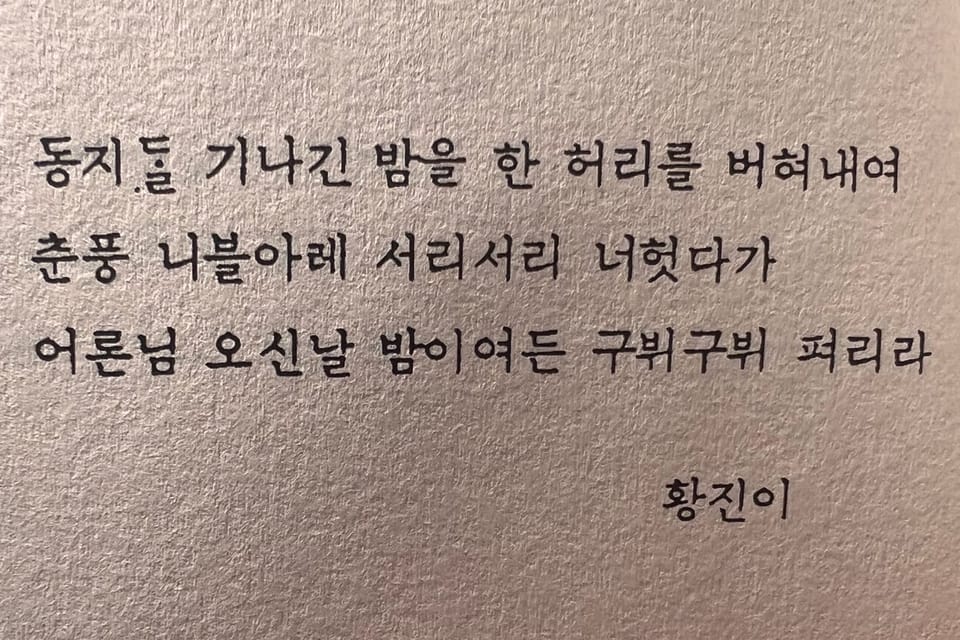
The second poet we worked on was Hwang Jin-Hi, a 15th century kisaeng, or courtesan—though you should click through each of the above links to get a sense of exactly what that meant in a Korean cultural context. Some people claim Hwang Jin-Hi as a kind of proto-feminist figure in Korean history. Her literary status can be broadly compared to Sappho’s, though there are important differences. This is the poem we translated:
The Long Mid-Winter Night
I will wrap the middle
of this long mid-winter night
round and round
in spring blankets
until my lover comes
and slowly
together
we can unravel it
around us.
I do not remember how we arrived at this version, nor can I find any of the notes we made or earlier drafts. I am struck, though, by how different it is from the version I found in Songs of the Kisaeng, translated by Constantine Contogenis and Wolhee Choe:
A Cold Solstice
At cold solstice I cut
the night, take its long waist
to my quilted bed,
curl up the dark under
broideries of spring, to wait
a night spread out again for you.
I will also add that the introduction to Songs of the Kisaeng provides a really interesting overview of who those women were and the lives they led.
§§§
The third poet we worked on was Kim Hu Ran. I have adapted this information from the Digital Library of Korean Literature: Deeply rooted in the more traditional forms of Korean lyricism, Kim Huran’s poetry is characterized by an intense exploration of symbolist imagery. Her poems explore the conflicts and contradictions of life with a modernist sensibility and capture the beauty and complexities of nature. Ms. Yu and I worked on two poem by Kim Hur Ran, “Land of Snow” and “The Miner.”
Land of Snow
Winter brings the world’s snow to cover me,
to make me a citizen of itself,
of its wordless commandment:
“Be silent. Be silent.
Be white and white, like snow.”
Lovers do not know winter.
They move like the blue feet of the fog,
like the bare feet of Isadora Duncan,
two flames combining in a blaze.
In winter, I gently fold my wings
and become a citizen of the land of snow.
But sometimes I am a flame,
and sometimes a tear hanging in air,
a snowflake filled with sorrow.
The Miner
A miner digs deep in the earth,
deep in the unplumbed darkness,
seeking words.
He chips away at the sleeping stones,
waking them. Charcoal black,
they, we,
emerge together—
you for the sake of me,
I for the sake of you—
to return once again
to the human truth
from which we come,
to go down, our vision
the perfect light
of virtuous miners,
and transform the night
into flame.
Subscribe to It All Connects...
It All Connects is for anyone who grapples with complexity—of identity, art-making, culture, or conscience—to make a difference in their own life and, potentially, in the life of their community.



Member discussion